


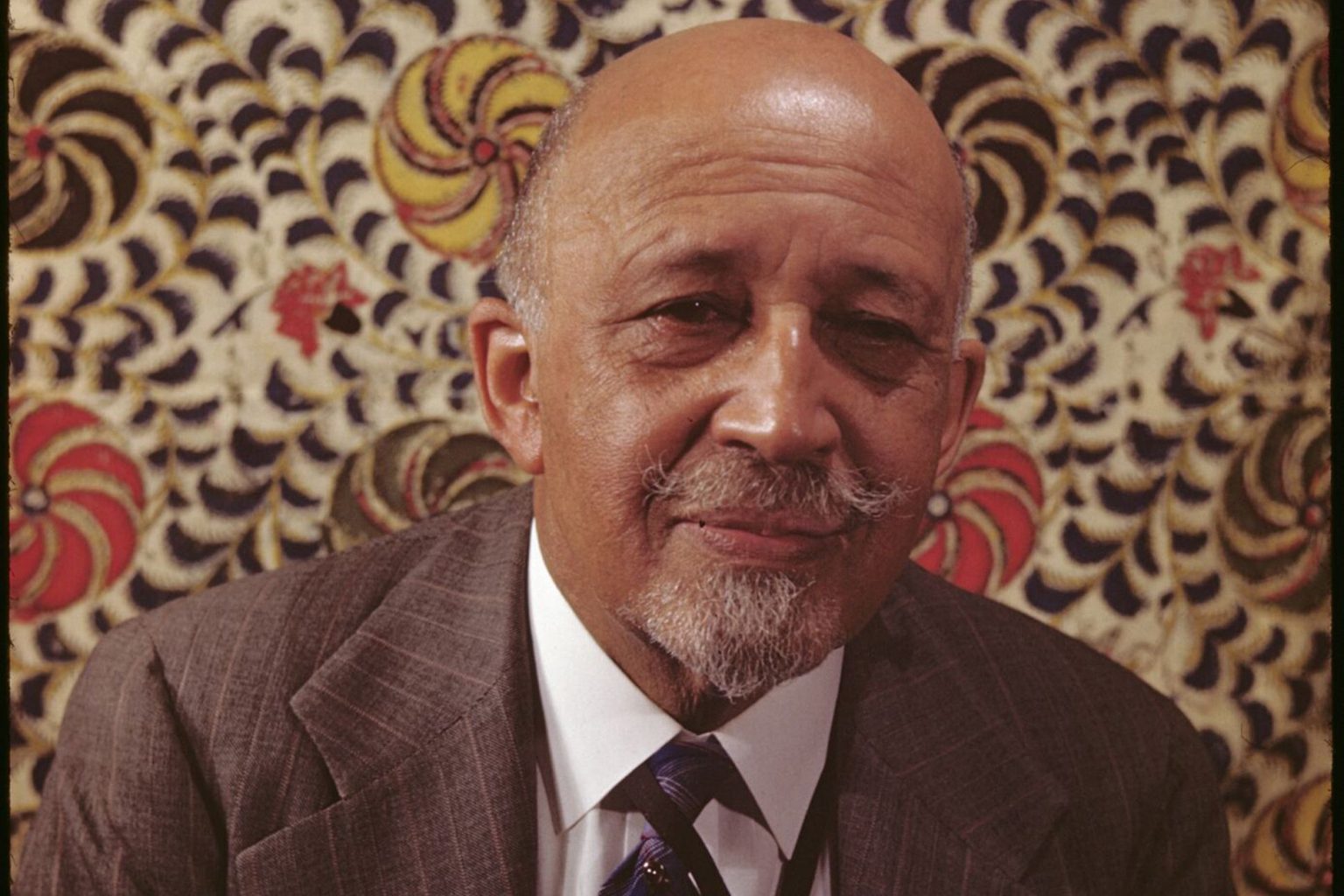
Introduction
William Edward Burghardt Du Bois (1868–1963) stands as a titanic figure in the intellectual and political landscape of the 20th century. A sociologist, historian, novelist, editor, and activist, his 95-year life was a relentless intellectual odyssey and a testament to the power of scholarship as a tool for liberation. His life’s work was animated by the prophetic declaration he made at the dawn of the century: “The problem of the twentieth century is the problem of the color-line”. This singular focus—on the division between the “darker and lighter races of men”—would guide his every endeavor, from his pioneering sociological studies to his leadership in global anti-colonial movements.
Du Bois’s enduring relevance lies not in a static ideology, but in his constant intellectual evolution. He was a figure of profound transformations, moving from an elite-driven integrationism to a race-conscious economic separatism, and finally to an internationalist, anti-capitalist worldview that culminated in his embrace of communism. He pioneered the synthesis of rigorous scholarship and passionate activism, believing that one could not simply study a problem but must actively work to solve it. In his quest to dismantle systemic oppression, he forged a new vocabulary for the Black experience, introducing concepts like “double consciousness” and “the Veil” that have become indispensable to understanding the psychology of race in America.
This report traces the arc of his remarkable life, examining the formative experiences that forged his consciousness, the intellectual and organizational battles that defined his public career, and the radical turn that led him to a final, symbolic pilgrimage to Africa. It is the story of a man who was not merely a participant in the great struggles of his time but was, in many ways, their chief diagnostician and prophet.
A Timeline of Influence: Key Events in the Life of W.E.B. Du Bois
| Year(s) | Life Event / Publication | Significance | Contemporary Context |
| 1868 | Born in Great Barrington, MA | Born into a free Black family in New England just three years after the Civil War’s end. | The 14th Amendment, granting citizenship to former slaves, is ratified. |
| 1885 | Enrolls at Fisk University | First sustained encounter with Southern Jim Crow and Black American culture, shaping his racial consciousness. | The “New South” era of industrialization and intensified racial segregation begins. |
| 1895 | Earns Ph.D. from Harvard University | Becomes the first African American to receive a Ph.D. from Harvard, establishing his scholarly credentials. | Booker T. Washington delivers his “Atlanta Compromise” speech. |
| 1903 | Publishes The Souls of Black Folk | Introduces concepts of “double consciousness” and “the Veil”; directly challenges Booker T. Washington’s leadership. | The Wright brothers make their first successful flight. |
| 1905 | Co-founds the Niagara Movement | Establishes an organization dedicated to aggressive protest for full civil rights, a radical alternative to Washington’s accommodationism. | Russia is defeated in the Russo-Japanese War, a shock to Western powers. |
| 1909 | Co-founds the NAACP | Helps create the nation’s premier and most enduring civil rights organization, merging the Niagara Movement’s core with white liberal allies. | Henry Ford introduces the Model T, revolutionizing American industry. |
| 1910 | Founds and edits The Crisis | As editor of the NAACP’s official magazine, he creates a national platform for Black thought, art, and protest, reaching 100,000 readers by 1920. | The “Great Migration” of African Americans from the South to the North begins. |
| 1919 | Organizes the first Pan-African Congress | Convenes delegates in Paris to advocate for the self-determination of African colonies, linking the American civil rights struggle to global anti-colonialism. | The Treaty of Versailles is signed, ending World War I. |
| 1935 | Publishes Black Reconstruction in America | Offers a groundbreaking Marxist reinterpretation of the post-Civil War era, centering Black agency and challenging the racist Dunning School of history. | The Great Depression is at its height; President Roosevelt’s New Deal programs are enacted. |
| 1951 | Indicted as an “unregistered foreign agent” | At age 83, he is persecuted by the U.S. government for his peace activism during the McCarthy era; he is later acquitted. | The Korean War is ongoing; Cold War tensions are at a peak. |
| 1961 | Joins the Communist Party USA; moves to Ghana | Renounces his American citizenship, embraces communism, and moves to Ghana at the invitation of President Kwame Nkrumah. | The Berlin Wall is constructed; the U.S.-backed Bay of Pigs invasion of Cuba fails. |
| 1963 | Dies in Accra, Ghana (August 27) | His death occurs on the eve of the March on Washington for Jobs and Freedom, where his passing is announced to the assembled crowd. | The March on Washington becomes a high-water mark for the Civil Rights Movement; President Kennedy is assassinated in November. |
Part I: The Forging of a Consciousness (1868-1903)
The intellectual architecture of W.E.B. Du Bois’s thought was built upon a foundation of unique and often contradictory experiences. His formative years were a journey across worlds: from the integrated yet isolating hills of New England to the vibrant, segregated heart of the Black South; from the hallowed halls of Harvard to the cosmopolitan lecture rooms of Berlin. Each stage provided a crucial piece of the puzzle, shaping the perspective that would allow him to diagnose the central malady of the modern world.
Section 1: A Son of New England and Africa
William Edward Burghardt Du Bois was born on February 23, 1868, in the small town of Great Barrington, Massachusetts, a world away from the Southern crucible of Reconstruction. His ancestry was a complex tapestry he would later meticulously study and weave into his life’s narrative. His maternal line, the Burghardts, had deep roots in the region, descending from Tom Burghardt, a man born in West Africa around 1730 who was enslaved by Dutch colonists but may have gained his freedom by serving in the American Revolutionary War. This lineage gave Du Bois a sense of belonging to the very soil of New England, a free Black family with a long history of land ownership. His paternal line was more itinerant. His father, Alfred Du Bois, was born in Haiti to a mixed-race Bahamian mother and a man of French Huguenot descent. Alfred served briefly and, it appears, desertedly in the Union Army before arriving in Great Barrington, where he married Mary Silvina Burghardt. Two years after William’s birth, Alfred left the family and never returned, leaving the young boy to be raised by his mother and the extended Burghardt clan.
This upbringing in Great Barrington was defined by a peculiar paradox. The town was predominantly white, with a Black population of fewer than fifty people, and Du Bois attended racially integrated public schools. He was supported by his family, encouraged by his teachers, and recognized for his precocious intellect. The principal, Frank Hosmer, mentored him, and when he decided to attend college, the local First Congregational Church raised his tuition money. In many ways, it was an environment of relative tolerance that nurtured his confidence and ambition.
Yet, this formal integration coexisted with a subtle but palpable social exclusion. As an adult, Du Bois wrote of the racism he felt as a fatherless child and a member of a tiny minority, learning early that even in New England, Black people were not fully accepted as equals. This was not the violent, legally codified racism of the Jim Crow South, but a more psychological form of alienation—the very essence of the “Veil” he would later describe. It was the experience of being
in the community but not entirely of it, a state of integrated alienation. This unique position provided him with an early, personal laboratory for observing the mechanics of the color line before he had the formal language to articulate them. His intellectual excellence became his primary tool for attempting to pierce that Veil, a way to prove his worth and transcend the unspoken social barriers. His formative years were thus not about escaping racism, but about experiencing a specific, insidious form of it that demanded an intellectual, rather than a physical, response, setting the stage for his entire career as a scholar-activist.
Section 2: The Awakening at Fisk
In 1885, Du Bois left the familiar world of New England for Fisk University, a historically Black college in Nashville, Tennessee. This move was a baptism by fire, a profound shock that inverted his prior experience and galvanized his life’s purpose. For the first time, he was confronted with the raw, brutal reality of Jim Crow segregation and the crushing poverty that was the legacy of slavery. The subtle social slights of Great Barrington were replaced by a rigid, violent, and all-encompassing system of racial caste.
Simultaneously, his time at Fisk was his first deep immersion in a vibrant, collective Black culture. In Great Barrington, he was a Black individual navigating a white world; at Fisk, he became part of a Black collective resisting a hostile white one. He felt a powerful sense of identification with his people, editing the student newspaper, the Fisk Herald, and engaging with a community of peers who shared his heritage and aspirations. This experience was deepened by the summers he spent teaching in the impoverished rural schools of eastern Tennessee, where he witnessed firsthand the resilience, faith, and “sorrow songs” of the Black folk whose souls he would later seek to reveal to the world.
This sharp juxtaposition—of brutal external oppression and rich internal community life—created the central tension of the Black experience he would later analyze with such brilliance. It was at Fisk, amidst his studies of philosophy, history, and law, that his intellectual ambition found its unwavering purpose: the uplift of his race. The concept of the “Talented Tenth” began to form in his mind here, not as an abstract theory of elitism, but as a direct, strategic response to the systemic powerlessness he saw all around him. He concluded that the Black community, beset by poverty and disenfranchisement, required its own college-educated vanguard—a cadre of leaders, thinkers, and professionals—to break down the structures of American racism and guide the masses to freedom and respect. Fisk was the crucible where his individual intellectual drive, forged in New England, was fused with a collective racial mission, transforming his personal ambition into a tool for liberation.
Section 3: In Harvard, But Not of It
After graduating from Fisk in 1888, Du Bois achieved his long-held dream of attending Harvard University. However, because Black colleges were not nationally accredited, he was forced to enroll as a junior, effectively repeating two years of his education. Despite this, his time at Harvard was an immense academic triumph. He earned a second B.A.
cum laude in 1890, followed by an M.A. in 1891, and culminated his studies by becoming the first African American to be awarded a Ph.D. from Harvard in 1895. He thrived in the university’s rigorous intellectual environment, studying under some of the nation’s leading minds. He was particularly influenced by the philosopher and psychologist William James and the historian Albert Bushnell Hart, both of whom became his mentors and friends, inviting him into their homes and recognizing his extraordinary talent. His doctoral dissertation,
The Suppression of the African Slave-Trade to the United States of America, 1638–1870, was a work of such distinction that it was chosen as the inaugural volume of the Harvard Historical Studies series, cementing his status as a first-rate scholar.
This intellectual integration stood in stark contrast to his social experience. He famously summarized his time in Cambridge with the phrase, “I was in Harvard, but not of it”. His social isolation was not a passive experience but a conscious, strategic choice. Having been fortified by the Black community at Fisk, he now viewed the white world of Harvard with a critical, analytical distance. He understood, as he later wrote, that seeking friendships with his white classmates would have led only to “disappointment and embitterment”. He lived off-campus, was denied a place in the glee club on what he believed were racial grounds, and largely kept to himself, focusing on his studies.
This willed detachment allowed him to master the tools of Western scholarship without being assimilated by its cultural norms. It was a perfect, real-world embodiment of the “double consciousness” he would later theorize so powerfully. He was operating as an American scholar at the highest level while remaining acutely aware of his position as a Negro, observing the white world from behind the Veil. He was simultaneously an intellectual insider and a social outsider, mastering the “tape of a world that looks on in amused contempt and pity” while refusing to let it define his soul. Harvard, therefore, was not just an academic milestone; it was the lived experience that provided the empirical data for his most profound psychological insight into the Black condition in America.
Section 4: A View from Berlin
From 1892 to 1894, a fellowship from the Slater Fund allowed Du Bois to pursue graduate studies at the Friedrich-Wilhelms-Universität (now Humboldt University) in Berlin, an experience that would globalize his perspective. In Germany, he encountered a society where the color line, while not absent, was not the all-consuming obsession it was in the United States. This relative freedom from the daily pressure of American racism was personally liberating, allowing him to feel, as he wrote, more “human” and to “cease to hate or suspect people simply because they belonged to one race or color”.
The intellectual impact of his time in Berlin was equally profound. He studied with some of Germany’s most influential social scientists, including the economic historian Gustav von Schmoller and the nationalist historian Heinrich von Treitschke. He was immersed in a vibrant, cosmopolitan academic culture, interacting with students from across Europe. This vantage point, from outside the American black/white binary, allowed him to re-conceptualize the “Negro Question.” He began to see it not as a unique American problem, but as a local manifestation of a global system of class, labor, and colonial exploitation. He drew a direct parallel between the “Social Question” (
Soziale Frage) concerning the industrial working class in Germany and the “Negro Question” (Neger-frage) in the United States, recognizing both as products of modern capitalism.
This perspective provided him with the global context and the scientific methodology that would elevate his analysis for the rest of his career. Schmoller and his colleagues in the German historical school advocated for a scholarship that was “both dispassionate and engaged,” blending rigorous, data-driven empirical research with a commitment to social reform—a model that would perfectly describe Du Bois’s own life’s work. Although the expiration of his fellowship prevented him from meeting the residency requirements to be awarded a German doctorate, the experience was transformative. As he later wrote, it was in Berlin that he “began to see the race problem in America, the problems of the peoples of Africa and Asia, and the political development of Europe as one”. Berlin internationalized his thought and radicalized his methodology. If Fisk gave him his mission and Harvard gave him the classical tools, Berlin provided the modern, scientific, and global framework to execute that mission on a world stage.
Part II: The Voice of a People (1903-1934)
Armed with an unparalleled education and a worldview forged across three continents, Du Bois entered the 20th century poised to challenge the established order. The period from 1903 to 1934 marked his ascent as the preeminent intellectual leader of Black America. It was an era of profound literary achievement, fierce ideological debate, and groundbreaking institution-building, during which he articulated the consciousness of a people and constructed the machinery of modern protest.
Section 5: The Souls of Black Folk: An American Manifesto
In 1903, Du Bois published The Souls of Black Folk, a collection of fourteen essays that immediately established itself as a landmark of American literature and a foundational text of sociological thought. The book was a stunning departure from the dry, academic prose of the era. It was a multi-genre masterpiece, weaving together history, sociology, autobiography, fiction, and cultural criticism in a lyrical, prophetic voice. Each chapter was hauntingly prefaced by “a bar of the Sorrow Songs”—spirituals that Du Bois presented as the singular artistic gift of Black America to the world and the deepest expression of its soul.
The book’s passionate tone was fueled by personal tragedy. During his time teaching at Atlanta University, Du Bois and his wife, Nina, lost their infant son, Burghardt, to diphtheria in 1899. They believed he might have been saved had they been able to find a white doctor willing to treat a Black child or had adequate medical facilities been available for the Black community. This devastating experience, which he recounted in the chapter “Of the Passing of the First-Born,” shattered any remaining belief he held in detached, purely objective scholarship. It convinced him that one could not simply study the color line; one had to fight it with every intellectual and emotional tool available.
Subsection 5.1: “The Problem of the Twentieth Century”: Unveiling the Color Line
The Souls of Black Folk took the concept of the “color line,” which Du Bois had first articulated at the 1900 Pan-African Conference, and made it the central metaphor for understanding modern American life. The book’s very title was a radical act of assertion. In an era when the humanity and interior life of Black people were widely questioned, the claim that they possessed “souls” worthy of examination was a profound challenge to the intellectual foundations of white supremacy. Du Bois framed racial division not as a peculiar Southern problem, but as a national and global crisis that corrupted the promise of democracy and diminished the humanity of both the oppressor and the oppressed. He argued that the legacy of racism had left the entire nation deficient in the basic human qualities upon which it was supposedly founded.
Subsection 5.2: The Psychology of Oppression: Double Consciousness and the Veil
The book’s most enduring contribution was its articulation of the psychological experience of being Black in America. Du Bois introduced two powerful and interconnected concepts: “the Veil” and “double consciousness.” The Veil was his metaphor for the color line itself—a thick, semi-transparent barrier that separated the Black and white worlds. For white people, the Veil was largely invisible, allowing them to exist without a true consciousness of how race shaped society. For Black people, it was an ever-present reality, a fabric that shaped every aspect of their existence, shutting them out from the world of opportunity while simultaneously granting them a unique perspective on that world.
Living within this Veil, Du Bois argued, produced a unique psychological state he termed “double consciousness.” He defined it in a now-famous passage from the opening essay, “Of Our Spiritual Strivings”:
“It is a peculiar sensation, this double-consciousness, this sense of always looking at one’s self through the eyes of others, of measuring one’s soul by the tape of a world that looks on in amused contempt and pity. One ever feels his two-ness,—an American, a Negro; two souls, two thoughts, two unreconciled strivings; two warring ideals in one dark body, whose dogged strength alone keeps it from being torn asunder.”
With this passage, Du Bois achieved something unprecedented. He translated a sociological observation into a national psychological diagnosis. Double consciousness was not merely a description of the Black experience; it was a profound indictment of an American society that produced such a psychic schism. By articulating this internal conflict between the American and Negro identities so poetically, he moved the “Negro Problem” from an external issue of laws and economics to an internal, existential crisis for the nation itself. He forced readers to confront the soul-warping effects of racism, making the specific pain of Black America a mirror that reflected the moral sickness of the entire country. The book became a manifesto for a new generation of activists and thinkers, including a young Martin Luther King Jr., and remains one of the most influential works ever written on the subject of race.
Section 6: The Great Debate: Du Bois vs. Washington
The publication of The Souls of Black Folk also marked Du Bois’s public break with the most powerful Black man in America: Booker T. Washington. Washington, the founder of the Tuskegee Institute, had risen to prominence following his 1895 “Atlanta Compromise” speech, in which he articulated a philosophy of accommodation to Jim Crow. He urged Black Americans to temporarily set aside their demands for political power, civil rights, and higher education. Instead, he argued, they should focus on acquiring vocational and agricultural skills, proving their economic value to the white South through hard work, thrift, and enterprise. This strategy, he believed, would gradually win the respect of whites and lead to full citizenship.
In the chapter “Of Mr. Booker T. Washington and Others,” Du Bois mounted a direct and devastating critique of this position. He argued that Washington’s program was a policy of submission that “practically accepts the alleged inferiority of the Negro races”. He contended that it was impossible to gain economic security without political power to protect it, and that abandoning the fight for civil rights was tantamount to surrendering one’s “manly self-respect”. Du Bois insisted that Black people must demand three things immediately: the right to vote, civic equality, and the education of youth according to ability. He championed higher education for a “Talented Tenth” who could serve as the intellectual vanguard for the race, a direct refutation of Washington’s emphasis on industrial training.
This clash was more than a mere disagreement over tactics; it was a fundamental battle over the definition of freedom and the soul of Black leadership. The two men’s philosophies were deeply rooted in their vastly different life experiences. Washington, born into slavery in the South, defined progress primarily in material and economic terms, believing that respect had to be earned through labor. Du Bois, a free-born Northerner educated at the world’s finest universities, defined freedom in terms of political power, intellectual development, and full, uncompromised human dignity, believing that rights were inherent and must be demanded. This great debate, which polarized the African American community into “conservative” and “radical” wings, created the central dialectic of Black political thought for the next half-century: the enduring tension between economic pragmatism and radical political protest.
Section 7: From Niagara to the NAACP: The Architecture of Protest
To give organizational form to his anti-Washington philosophy, Du Bois, along with the militant Boston newspaper editor William Monroe Trotter, issued a call to a select group of Black intellectuals in 1905. Twenty-nine men from fourteen states gathered that July, and after being denied accommodation in Buffalo, New York, they met across the river at the Erie Beach Hotel in Fort Erie, Ontario. Naming their new organization the Niagara Movement, after the “mighty current” of change they hoped to unleash, they drafted a “Declaration of Principles”. This document was a radical manifesto for its time, demanding an immediate end to all forms of segregation and discrimination and calling for “persistent manly agitation” to secure full manhood suffrage and equal rights.
The movement held subsequent meetings, most symbolically in 1906 at Harpers Ferry, West Virginia, the site of John Brown’s abolitionist raid, where members made a barefoot pilgrimage to Brown’s fort. However, the Niagara Movement was plagued by chronic problems. It lacked stable funding, suffered from internal disagreements (including a dispute between Du Bois and Trotter over the admission of women), and faced relentless opposition from Washington’s powerful “Tuskegee Machine,” which used its influence to undermine the upstart organization.
Though the Niagara Movement was short-lived and organizationally weak, it was a pivotal strategic success. It created the first formal, institutional home for the radical alternative to Washington’s accommodationism, proving that an organized opposition was possible and breaking Washington’s monopoly on Black political discourse. Its ultimate “failure” became its greatest success. In August 1908, a brutal race riot erupted in Springfield, Illinois—the hometown of Abraham Lincoln—shocking the nation. In response, a group of white liberals, including Mary White Ovington and Oswald Garrison Villard, issued a call for a new, interracial organization to fight for Black rights. They joined forces with the core leadership of the Niagara Movement, including Du Bois. In 1909, this coalition founded the National Association for the Advancement of Colored People (NAACP). The Niagara Movement formally disbanded in 1911, its mission absorbed and its members forming the ideological backbone of what would become the most influential civil rights organization of the 20th century. Niagara was the radical prototype that laid the groundwork for the modern civil rights machine.
Section 8: The Crisis: Editor as Advocate
As a co-founder of the NAACP, Du Bois became its Director of Publicity and Research and the only African American on its initial board of directors. His most significant role, however, began in 1910 when he founded
The Crisis, the organization’s official monthly magazine. For the next twenty-four years, Du Bois served as its editor, wielding near-total control over its content and shaping it into one of the most influential periodicals in American history.
He declared that the magazine’s purpose was to be “a record of the darker races” and to “set forth those facts and arguments which show the danger of race prejudice”. Under his leadership,
The Crisis was a phenomenal success, its circulation soaring from 1,000 in its first year to a peak of 100,000 by 1920. It was more than a house organ; it was the engine that created a modern, national Black public sphere. In an era when mainstream media either ignored Black life or depicted it through racist caricature,
The Crisis provided a common set of facts, a shared language of protest, and a unified vision of cultural pride.
The magazine’s content was a deliberate mix of advocacy and art. It published stark, data-driven reports on the horrors of lynching, relentlessly pushing for federal anti-lynching legislation. It championed political rights, exposed discrimination, and celebrated Black achievement in every field. Crucially, it also became a primary outlet for the creative talents of the Harlem Renaissance. Du Bois, along with literary editor Jessie Redmon Fauset, published the early works of Langston Hughes, Countee Cullen, Jean Toomer, and many others, making
The Crisis a vital crucible for the most important Black literary movement of the century. By controlling this powerful narrative vehicle, Du Bois bypassed the white-dominated press and spoke directly to Black America, transforming disparate and isolated communities into an informed, connected, and mobilized national constituency.
Part III: The Global and Radical Turn (1934-1963)
The final three decades of Du Bois’s life were characterized by a profound radicalization and an expansion of his vision from a national to a global stage. Increasingly disillusioned with the pace of change in the United States and the limitations of liberal reform, he delved deeper into Marxist thought, championed global anti-colonialism, and ultimately found himself alienated from the very country he had spent a lifetime trying to perfect.
Section 9: Black Reconstruction: Rewriting American History
In 1934, Du Bois resigned from the NAACP and The Crisis after a sharp disagreement with the board over his evolving stance on segregation, which he had begun to see as a potential basis for Black economic self-sufficiency. Returning to academia at Atlanta University, he produced his historical magnum opus in 1935:
Black Reconstruction in America, 1860–1880. The book was a monumental and revolutionary act of historical revisionism. It was a direct assault on the prevailing Dunning School of historiography, a racist academic consensus that portrayed the Reconstruction era as a tragic failure caused by the corruption of Northern “carpetbaggers” and the ignorance of newly enfranchised Black voters.
Du Bois systematically dismantled this narrative, using a Marxist framework to reinterpret the entire period. He argued that the Civil War’s outcome was determined not solely by the Union Army, but by a “general strike” of four million enslaved people who strategically withdrew their labor from the Confederate war effort, crippling its economy and flocking to Union lines. He re-centered the story on the agency of these freedpeople, who he showed were the primary actors in the drama, actively demanding rights, creating democratic state constitutions, and establishing, for the first time in the South, a system of free public education for all.
Black Reconstruction was more than a corrective history; it was a theoretical treatise on the relationship between race and class in a capitalist society. Du Bois argued that the great tragedy of the era was the failure of poor white and Black laborers to unite against the white planter-capitalist class. He explained this failure with a groundbreaking concept: the “public and psychological wage” paid to white workers. Though they received low monetary wages, they were compensated with public deference, access to better schools and parks, and leniency in the courts—privileges that elevated them above Black workers and tied their identity to the ruling class. Racism, in this analysis, was not an irrational prejudice but a calculated tool of class oppression used by capital to divide and conquer the working class. By writing a history of the 1870s during the labor upheavals of the 1930s, Du Bois was using the past to diagnose the present, arguing that no future for American democracy was possible without confronting the deep-seated, materialist roots of the color line.
Section 10: The Father of Pan-Africanism
Du Bois’s analysis of the color line was never confined to the borders of the United States. From early in his career, he understood that the oppression of Black Americans was inextricably linked to the global system of European colonialism. This internationalist perspective made him the principal architect and “father of modern Pan-Africanism”. His formal involvement began with the first Pan-African Conference held in London in 1900, where he drafted the famous “To the Nations of the World” address that contained his “color-line” prophecy.
After World War I, he seized the opportunity of the Paris Peace Conference to organize the first Pan-African Congress in 1919. His goal was to petition the world powers to begin a process of self-rule for African colonies, connecting the Wilsonian ideal of self-determination to the peoples of Africa. He continued to organize a series of congresses throughout the 1920s—in London, Brussels, and Paris in 1921, and again in 1923 and 1927—bringing together intellectuals and activists from Africa, the West Indies, and the United States.
For Du Bois, Pan-Africanism was the logical and necessary extension of his life’s work. He saw the Jim Crow South and colonial Africa as two fronts in the same global war against white supremacy and capitalist exploitation. The Pan-African Congresses were his grand strategy to forge an international front of the “darker races,” creating a unified political and intellectual force to challenge the hegemony of empire. This work had a profound impact, inspiring a generation of future African independence leaders, including Kwame Nkrumah of Ghana, Jomo Kenyatta of Kenya, and Nnamdi Azikiwe of Nigeria, who attended the 1945 Pan-African Congress in Manchester and saw Du Bois as their ideological forefather.
Section 11: A Prophet Under Siege: The Cold War and McCarthyism
After a ten-year hiatus, Du Bois returned to the NAACP from 1944 to 1948 as Director of Special Research. In the nascent post-World War II era, he channeled his energies into international affairs, attending the founding conference of the United Nations and lobbying the new global body to address the plight of African Americans and the injustices of colonialism. His increasing focus on peace activism and his sympathies for the Soviet Union, however, put him on a collision course with the U.S. government as the Cold War intensified.
His activism with the Peace Information Center (PIC), an organization that circulated the Stockholm Peace Appeal calling for a ban on nuclear weapons, made him a target of the McCarthy-era anti-communist hysteria. In February 1951, at the age of 83, Du Bois was handcuffed, indicted, and put on trial by the Department of Justice, charged with being an “unregistered agent of a foreign power”. The prosecution was a political show trial, an attempt to silence one of the nation’s most powerful critics of American foreign policy and racial inequality. A national and international defense committee rallied to his cause, and in November 1951, a federal judge acquitted him, stating the government had failed to present any credible evidence.
The acquittal was a legal victory but a devastating personal and political blow. The U.S. State Department confiscated his passport, preventing him from traveling abroad for eight years. He was vilified in the press and marginalized from the mainstream Civil Rights Movement, which was under immense pressure to distance itself from anyone with alleged communist sympathies. The persecution of Du Bois revealed a critical truth about the Cold War: the fight against communism was often used as a weapon to suppress the Black freedom struggle. By branding the nation’s preeminent Black intellectual as “un-American,” the government sought to sever the vital link between the domestic movement for racial justice and the global movement against colonialism and war, forcing a false choice between being an American and being a radical critic of America.
Section 12: The Final Pilgrimage: Communism, Ghana, and Legacy
The final years of Du Bois’s life were a dramatic culmination of his intellectual and political journey. Stripped of his passport and isolated at home, he became increasingly disillusioned with American capitalism, which he had long believed to be the root cause of racism. His long-standing interest in socialist thought, which began with his attendance at Social Democratic Party meetings in Berlin in the 1890s and a brief membership in the American Socialist Party in 1911, now deepened into a full embrace of communism. He admired the Soviet Union and the People’s Republic of China for their official anti-racist stances and their state-led efforts at economic development. In 1961, shortly after the Supreme Court restored his passport rights, the 93-year-old Du Bois made his final, definitive political statement by formally joining the Communist Party USA.
That same year, he accepted an invitation from his ideological disciple, President Kwame Nkrumah, to move to Ghana, the first sub-Saharan African nation to achieve independence from colonial rule. There, he renounced his American citizenship and became a citizen of Ghana, embarking on his last great scholarly project: directing the creation of an
Encyclopedia Africana. This final act was not one of surrender but of profound symbolic logic. It was the ultimate rejection of the “American” side of his double consciousness in favor of the “Negro” soul, which he had come to define in global, Pan-African terms. Having been persecuted for his attempts to merge his “two-ness” within the United States, he resolved the conflict by physically relocating to the free Africa his life’s work had helped to envision.
On August 27, 1963, W.E.B. Du Bois died in the capital city of Accra. His death occurred on the very eve of the March on Washington for Jobs and Freedom. The next day, before a crowd of over 250,000 people gathered at the Lincoln Memorial, NAACP leader Roy Wilkins announced his passing, stating, “Regardless of the fact that in his later years Dr. Du Bois chose another path, it is incontrovertible that at the dawn of the twentieth century his was the voice that was calling you to gather here today”. This juxtaposition is one of modern history’s most powerful. As the mass movement he helped to birth reached its popular zenith, its intellectual father found his final home and peace not in the America he fought to change, but in the Africa he fought to free.
Conclusion
The life of W.E.B. Du Bois was a 95-year arc of intellectual striving and political struggle, a relentless quest to understand and dismantle the global system of racial oppression. From his formative years in the paradoxical world of New England to his final days as an expatriate in a newly independent Africa, his journey was one of constant growth, re-evaluation, and radicalization. He began as a scholar, believing that the truth, rigorously researched and clearly articulated, could set his people free. He became an activist and an organizer, building the institutional architecture of protest that would carry the fight for civil rights through the 20th century. He ended as a global prophet, diagnosing the color line as a function of capitalism and empire, and linking the fate of Black Americans to the liberation struggles of colonized peoples around the world.
His intellectual legacy is monumental. With The Souls of Black Folk, he gave the world the language of “double consciousness” and “the Veil,” providing a timeless psychological framework for understanding the experience of marginalized peoples. With Black Reconstruction in America, he single-handedly rewrote the history of the nation’s most critical era, centering Black agency and introducing a class-based analysis of racism that remains profoundly influential. As the editor of The Crisis and the father of the Pan-African Congresses, he forged a national and international Black public sphere, creating a shared consciousness of struggle and pride.
His political journey, culminating in his embrace of communism and his renunciation of American citizenship, remains a subject of debate. Yet, it can be understood as the logical endpoint of a life spent confronting the failures of American democracy. Persecuted for his advocacy of peace and his critique of imperialism, Du Bois concluded that the system itself was irredeemable and that true liberation lay in a global, anti-capitalist future. His death on the eve of the March on Washington serves as a poignant and powerful symbol: a reminder that while the struggle for civil rights was a quintessentially American drama, its greatest intellectual architect ultimately saw the solution beyond America’s borders. W.E.B. Du Bois remains an indispensable thinker, a testament to a life of unceasing intellectual courage and an unwavering commitment to the liberation of the world’s darker races.

