


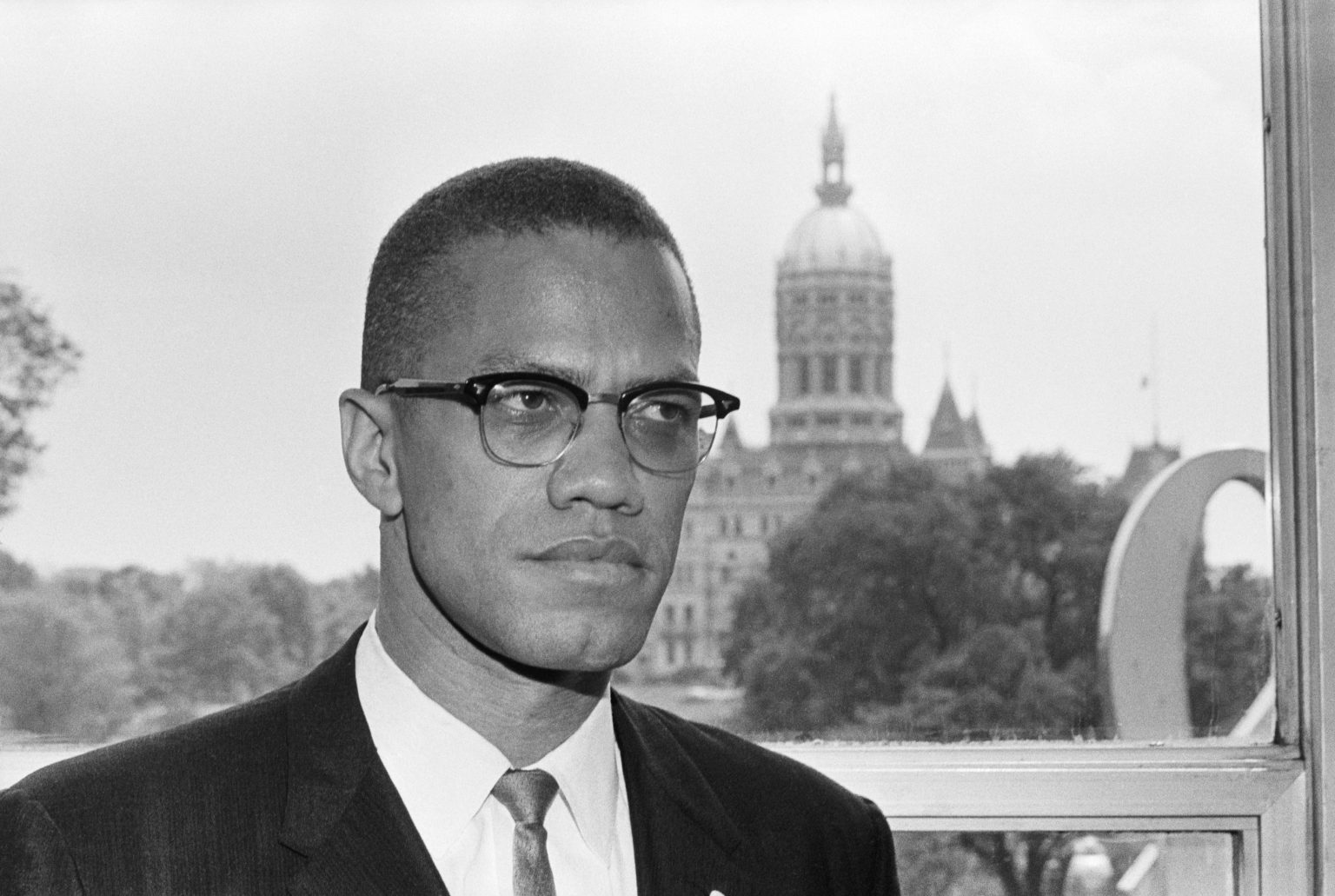
Introduction: The Man of Many Names
The life of Malcolm X is a profound narrative of transformation, a journey through identities that mirrored the tumultuous search for Black identity, dignity, and self-determination in 20th-century America. To understand this towering and controversial figure is to understand the distinct yet interconnected men he became: born Malcolm Little, a name inherited from the legacy of slavery; hardened into “Detroit Red,” a street hustler navigating the urban underworld; reborn in prison as Malcolm X, the fiery, ascetic minister of the Nation of Islam (NOI); and finally, in the last year of his life, remade once more as El-Hajj Malik El-Shabazz, an orthodox Sunni Muslim and Pan-Africanist with a global vision of human rights. His life was not a single, linear progression but a series of radical rebirths, each a logical and deeply considered response to the circumstances he confronted and the knowledge he acquired. This biographical analysis posits that Malcolm X’s continuous evolution serves as a powerful microcosm of the Black American struggle, charting a course from the inherited trauma of white supremacy to a sophisticated, internationalist vision for liberation. His story is not merely that of one man, but of a people grappling with the fundamental questions of identity, power, and justice in a nation that had systematically denied them all three.
Part I: The Crucible of Youth (1925-1946)
Chapter 1: A Garveyite Inheritance
Malcolm Little was born on May 19, 1925, in Omaha, Nebraska, into a family already deeply entrenched in the struggle for Black liberation. His parents, Earl and Louise Little, were not passive victims of racism but active agents of resistance. His Georgia-born father, the Reverend Earl Little, was an outspoken Baptist minister and a dedicated chapter president for Marcus Garvey’s Universal Negro Improvement Association (UNIA), a movement that championed Black pride, economic independence, and the eventual return of the African diaspora to their ancestral homeland. His mother, Louise Little, born in Grenada, was a multilingual and educated woman who served as the secretary and “branch reporter” for the local UNIA chapter, sending news of their activities to the organization’s newspaper,
Negro World.
The household was a political classroom. From their earliest years, the Little children were inculcated with the core tenets of Garveyism: self-reliance, racial pride, and a Pan-Africanist consciousness that connected their fate to that of Black people globally. Young Malcolm often accompanied his father to UNIA meetings, absorbing the powerful rhetoric of Black nationalism long before he could fully articulate it himself. This upbringing was foundational. The core principles that would later define Malcolm X’s public ministry—a deep skepticism of white institutions, an insistence on economic self-sufficiency, a celebration of Black history, and a connection to Africa—were not ideas he discovered in prison or invented in Harlem. They were his inheritance. His later embrace of the Nation of Islam was not a conversion out of an ideological void, but the adoption of a new theological framework that resonated powerfully with the political philosophy he had absorbed at his father’s side. This establishes a direct and unbroken ideological lineage from the Pan-Africanism of Garvey to the household of Earl Little, and ultimately to the international stage commanded by Malcolm X.
Chapter 2: The Unraveling
The Little family’s activism made them a direct and constant target for white supremacist violence. Shortly after Malcolm’s birth, threats from the Ku Klux Klan forced them to flee Omaha. After brief stays in Milwaukee and East Chicago, they settled in Lansing, Michigan, only to find the persecution continued. In 1929, their home was burned to the ground by a white supremacist group known as the Black Legion. Malcolm, only four years old, later recalled being “snatched awake into a frightening confusion of pistol shots and shouting and smoke and flames”.
The family’s gravest tragedy struck in 1931. When Malcolm was six, Earl Little was killed, his body nearly severed by a streetcar. Though authorities officially ruled his death an accident, the family and the Black community were convinced he had been murdered by the Black Legion. The family’s economic standing, already precarious, collapsed. Their financial ruin was sealed when one of Earl’s life insurance policies refused to pay out, the issuer claiming his death was a suicide—a cruel and common tactic used to deny benefits to the families of lynching victims.
The immense psychological and financial pressure proved overwhelming for Louise Little. Left to raise eight children alone during the Great Depression, her mental health deteriorated. After a man she had been dating abandoned her when she became pregnant with her eighth child, she suffered a complete nervous breakdown. In 1938, she was declared legally insane and committed to the Kalamazoo State Mental Hospital, where she would remain for the next 26 years. With their mother institutionalized, the family unit was shattered. Malcolm and his siblings were separated and became wards of the court, scattered among various foster homes.
The destruction of the Little family reveals a two-pronged assault characteristic of systemic racism. First came the direct, extralegal terror of white supremacist organizations like the KKK and the Black Legion, which the state apparatus either could not or would not prevent or prosecute. This violence created the conditions of trauma and poverty that made the family vulnerable. Then came the intervention of the state’s welfare and mental health systems. Instead of providing support to a grieving widow and her children, these institutions pathologized Louise’s response to her circumstances, ultimately using bureaucratic power to achieve what the night-riders could not: the complete dissolution of a proud, activist Black family. This childhood experience provided Malcolm with the empirical evidence for his later, deeply held conviction that American institutions—from law enforcement to social services—were not neutral arbiters of justice but active instruments of racial oppression.
Chapter 3: The Education of “Detroit Red”
Despite the profound instability of his youth, Malcolm was intellectually gifted and initially thrived in his new environment. Placed in a juvenile home in the nearly all-white community of Mason, Michigan, he excelled academically and socially, earning top grades and being elected president of his otherwise white eighth-grade class. The pivotal moment that re-charted his life’s course came not from a Klansman’s hood, but from the mouth of a trusted teacher. When Malcolm expressed his ambition to become a lawyer, his white English teacher advised him that this was “no realistic goal for a nigger” and that he should pursue a manual trade like carpentry. This single encounter was a devastating lesson in the invisible architecture of American racism. It taught him that even with talent and ambition, the system had already circumscribed his future. He lost all interest in formal education and soon dropped out.
At fifteen, he sought refuge and a new start with his older half-sister, the formidable Ella Little-Collins, in Boston. The vibrant Black culture of the Roxbury neighborhood was a thrilling revelation, a world teeming with a confidence and style he had never witnessed. He quickly shed the persona of the rural Michigan schoolboy. Rejecting Ella’s attempts to enroll him in school and impose discipline, he was drawn to the glamour and danger of the city’s underworld. He took a series of menial jobs—shining shoes at the Roseland State Ballroom, washing dishes, and working as a fourth-class cook on the railroad—but these were merely staging grounds for his real education on the streets.
Moving between Boston, where he was known as “New York Red,” and New York City, where he was called “Detroit Red,” he fully immersed himself in the life of a hustler. He sported flamboyant zoot suits, dyed his hair red, and financed his lifestyle through an array of criminal activities, including drug dealing, gambling, racketeering, pimping, and eventually, leading a burglary ring. This period was more than a simple descent into crime; it was a form of rebellion. The hustle was a rejection of a society that offered him only servitude and a desperate attempt to seize a measure of control and economic independence. The principles of self-reliance and Black enterprise instilled by his Garveyite parents, finding no outlet in the legitimate world that had been closed to him, became perversely manifested in the underground economy. His criminal career can thus be understood not merely as a moral failure, but as a tragic misapplication of the very virtues of self-determination his parents had taught him, a direct consequence of a racist system that left him no other perceived path to power. This chapter of his life came to an abrupt end in 1946 when, at the age of 20, he was arrested for grand larceny, convicted, and sentenced to an unusually harsh eight to ten years in prison.
Part II: The Rebirth in Incarceration (1946-1952)
Chapter 4: The University of Norfolk Prison
Malcolm Little entered the Massachusetts prison system an embittered and volatile young man. In the notorious Charlestown State Prison, his rage and profanity earned him the nickname “Satan” among his fellow inmates. Yet, it was within the walls of his confinement that the most profound transformation of his life began. The catalyst was a fellow inmate, an older, self-taught man named John Elton Bembry, whom Malcolm called “Bimbi”. Bimbi’s intellect and command of language inspired Malcolm to redirect his sharp mind from the hustle to the library. This encounter ignited a ferocious commitment to self-education. He started with the most fundamental tool: the word. He began meticulously copying every entry from a dictionary, page by page, to build a vocabulary that could articulate the complex thoughts and frustrations raging within him.
His half-sister, Ella, remained a crucial force in his life, using her resources and connections to advocate for his transfer to better facilities. She succeeded in getting him moved first to the Concord Reformatory and later, in 1948, to the experimental and more progressive Norfolk Prison Colony. Norfolk was a world away from Charlestown; it had a well-stocked library and, most importantly, a renowned debating society. It was here that Malcolm’s intellectual journey accelerated. He devoured books on history, philosophy, and religion, and he threw himself into the prison’s debate program. He sharpened his forensic skills in weekly debates, taking on teams from prestigious universities like Harvard, Yale, and the Massachusetts Institute of Technology. He would later credit this experience as his “baptism into public speaking,” the place where he forged the formidable rhetorical weapons that would define his public career.
This period presents a striking paradox: the institution designed to physically confine Malcolm became the very crucible that liberated his mind. This was not a product of the penal system’s rehabilitative design, but a subversion of it, made possible by a confluence of unique factors. The prison environment removed him from the daily dangers and distractions of street life, affording him the time and security for deep reflection. The persistent advocacy of his sister Ella ensured he had access to critical intellectual resources. The presence of a jailhouse mentor in Bimbi provided the initial spark, and the structured forum of the debating society allowed him to transform raw intelligence and righteous anger into disciplined, persuasive oratory. The state had incarcerated “Detroit Red,” the hustler; in doing so, it inadvertently created the conditions for the emergence of Malcolm X, the intellectual revolutionary.
Chapter 5: The Messenger’s Call
While Malcolm was remaking his intellect, his family was laying the groundwork for his spiritual rebirth. Several of his siblings, most notably his brother Reginald, had joined the Nation of Islam (NOI), a religious and Black nationalist movement led by the Honorable Elijah Muhammad. During visits and in letters, they introduced Malcolm to the NOI’s teachings. The theology was a radical and compelling explanation for the suffering he had witnessed his entire life. It taught that Black people were the “Original Man,” the progenitors of civilization, and that white people were a race of “devils” created through a corrupt breeding process to oppress and enslave the world’s non-white peoples. For a man whose family had been destroyed by white supremacy, this doctrine was not an abstraction; it was a theology that perfectly matched his lived experience.
Intrigued and compelled, Malcolm began a correspondence from his cell at Norfolk with Elijah Muhammad himself. He fully embraced the discipline of the Nation, quitting smoking, giving up pork in accordance with the group’s dietary laws, and dedicating himself to prayer. In 1950, he took a decisive step in shedding his old identity. Following the custom of NOI members, he replaced his surname, “Little,” with an “X”. This act was laden with symbolic power. The “X” signified the rejection of the surname given to his ancestors by a white slave master, while simultaneously representing the true African family name that had been stolen and lost to history. It was his first public act of self-naming, a declaration of independence from a past defined by white ownership and a claim to a new identity rooted in a reclaimed, if unknown, African heritage. When he was released on parole in August 1952, after serving six and a half years, the man who walked out of prison was no longer Malcolm Little. He was Malcolm X, a man with a new name, a new faith, and a singular, burning purpose.
Part III: The Voice of the Nation (1952-1963)
Chapter 6: The Minister’s Ascent
Upon his release from prison, Malcolm X traveled to Detroit and formally joined the Nation of Islam, dedicating himself completely to the service of its leader, Elijah Muhammad. His innate charisma, boundless energy—he often slept only four hours a night—and the powerful oratorical skills he had honed in prison made him an exceptionally effective organizer and minister. His ascent within the organization was meteoric. In 1953, he was appointed assistant minister of Detroit’s Temple No. 1. Shortly thereafter, Elijah Muhammad dispatched him to the East Coast, where his impact was immediate and profound. He founded Temple No. 11 in Boston and established new temples in Philadelphia and Hartford. In 1954, he was rewarded with the most prestigious field appointment in the Nation: minister of Temple No. 7 in Harlem, New York City.
Under his dynamic leadership, the Nation of Islam transformed from a small, fringe sect into a significant national movement. He was the primary engine of its growth. Traveling relentlessly up and down the East Coast, he brought thousands of new converts into the fold. Largely as a result of his efforts, the NOI’s membership exploded, growing from an estimated 400 members in 1952 to a claimed 40,000 members by 1960. To further amplify the Nation’s message, he founded its official newspaper,
Muhammad Speaks, which became a vital tool for recruitment and ideological dissemination. His success and loyalty earned him the title of National Representative, making him the public face of the Nation of Islam and second in influence only to Elijah Muhammad himself.
In 1958, he married Betty Sanders, a nurse and educator whom he had met at a Temple No. 7 lecture. Betty, who became Sister Betty X, was a devoted partner in his work and life. Together, they would have six daughters: Attallah, Qubilah, Ilyasah, Gamilah, and twins Malaak and Malikah, who were born after his death.
Chapter 7: The Philosophy of Separation
As the Nation of Islam’s chief spokesman, Malcolm X articulated a philosophy that presented a radical and challenging alternative to the integrationist, nonviolent ethos of the mainstream Civil Rights Movement. His message was a potent combination of Black pride, economic self-sufficiency, and uncompromising resistance. He preached a doctrine of strict personal morality and discipline, urging followers to live clean lives free from alcohol, drugs, and crime, which he argued were tools of white oppression. The ultimate goal, he argued, was not integration into a corrupt and racist white society, but complete separation from it. This separation would allow Black people to build and control their own institutions—schools, businesses, and communities—free from white interference.
He was a fierce critic of the nonviolent strategy espoused by leaders like Dr. Martin Luther King, Jr.. He famously argued that it was illogical and cowardly for Black people to remain nonviolent in the face of the brutal, daily violence of white supremacy. Instead, he insisted on the right of Black people to defend themselves “by any means necessary”. In his 1963 speech “Message to the Grassroots,” he derided the “Negro revolution” as the only revolution in history where the oppressed were asked to love their enemy. He saw no American dream, only an “American nightmare,” and his unsparing critiques gave voice to the pent-up anger and frustration of millions of Black Americans, particularly in the urban North, who felt that the mainstream movement did not speak to their reality.
This oppositional stance, however, was not merely destructive; it served a crucial, dialectical function within the broader Black freedom struggle. Malcolm X’s fiery rhetoric and embrace of armed self-defense made the demands of the nonviolent movement appear far more moderate and palatable to the white political establishment. His radicalism created a political space in which Dr. King’s calls for integration and civil disobedience could be seen as a reasonable compromise, thereby inadvertently aiding the passage of landmark legislation. Furthermore, his relentless focus on the systemic nature of racism in the North challenged the Southern-focused narrative of the mainstream movement, forcing a more comprehensive and radical analysis of racial injustice as a national, not regional, problem. He was not simply Dr. King’s opposite; he was a necessary and complementary force who expanded the ideological boundaries of the struggle, articulated the righteous anger of the dispossessed, and laid the intellectual groundwork for the Black Power movement that would soon follow.
Chapter 8: Cracks in the Foundation
As Malcolm X’s profile grew, so did the internal and external pressures on him and the Nation of Islam. His eloquence, sharp intellect, and savvy with the media made him a star, eclipsing his mentor, Elijah Muhammad. This generated significant jealousy and suspicion among the NOI’s leadership in Chicago, who began to see him as a rival for power and influence. Simultaneously, his rising prominence made him a primary target for government surveillance. The Federal Bureau of Investigation (FBI) monitored him constantly, viewing the NOI’s nationalist and separatist ideology as a threat to national security.
Internal tensions were exacerbated by growing ideological disagreements. Malcolm became increasingly frustrated with Elijah Muhammad’s policy of political non-engagement. He believed the NOI should be an active force in the fight for civil rights, not just a critic from the sidelines. This frustration boiled over after incidents of unprovoked police brutality against NOI members, such as the 1962 raid on the Los Angeles mosque that left one member dead and several others wounded. Malcolm wanted to organize a direct, forceful response, but Muhammad forbade it, a decision that stunned and deeply troubled his most loyal minister.
The most devastating blow, however, was personal and moral. In 1963, Malcolm learned from Elijah Muhammad’s own sons that his revered leader had violated the Nation’s strict moral code by fathering children with at least six of his young personal secretaries. For Malcolm, who had embraced the NOI’s puritanical discipline as the source of its strength and moral authority, this hypocrisy was a profound betrayal. The man he had considered a divine messenger, the man who had saved him from a life of crime and given him purpose, was a fraud. This discovery shattered the foundation of his faith and set him on an inexorable path toward a break with the organization he had done so much to build.
Part IV: The Break and the Pilgrimage (1964)
Chapter 9: The Silencing and the Split
The final rupture between Malcolm X and the Nation of Islam was precipitated by a remark that, in the context of his typically fiery rhetoric, seemed almost subdued. On December 1, 1963, shortly after the assassination of President John F. Kennedy, a reporter asked for his comment. Malcolm replied that the assassination was a case of “chickens coming home to roost,” explaining that the climate of violence that America had long fostered against others, both at home and abroad, had finally claimed its own leader. The statement caused a national firestorm of outrage. For Elijah Muhammad, who was already seeking a way to sideline his increasingly popular and independent-minded minister, the controversy provided the perfect pretext. He publicly censured Malcolm and ordered him to observe a 90-day period of silence, forbidding him from speaking to the press or at any public gatherings.
During this period of forced silence, Malcolm came to understand that the forces arrayed against him within the NOI were insurmountable and that his suspension was not temporary but a prelude to his permanent ouster. He realized he could no longer operate within an organization whose leader he no longer believed in and whose hierarchy was actively working against him. On March 8, 1964, Malcolm X publicly announced his definitive break from the Nation of Islam. He declared that he was still a Muslim, but he felt the Nation had “gone as far as it can” because of its rigid, racially-based teachings and its refusal to engage in the broader freedom struggle. He was now a man without a movement, charting a new and uncertain course.
Chapter 10: The Journey to Mecca
In April 1964, seeking spiritual clarity and a deeper connection to his faith, Malcolm embarked on the Hajj, the sacred pilgrimage to Mecca that is a duty for all able-bodied Muslims. This journey would catalyze the second great transformation of his life, an epiphany as profound as his conversion in prison. For the first time, he was immersed in the global community of Islam, and what he witnessed fundamentally shattered the racial theology of the Nation of Islam. In the holy city of Mecca, he saw millions of pilgrims from every corner of the earth, of every conceivable color and nationality—”from blue-eyed blonds to black-skinned Africans”—living, eating, and praying together in a spirit of absolute equality and brotherhood.
The rituals of the Hajj themselves were a powerful lesson in unity. He donned the ihram, the simple, two-piece white garment worn by every male pilgrim, which erases all signs of status, wealth, and race. In this sea of white-clad humanity, it was impossible to distinguish “a king or a peasant,” a visual and spiritual manifestation of the equality of all people before God. He wrote in his autobiography of the powerful experience of eating from the same plate and drinking from the same glass as white Muslims, an act of fellowship that would have been unthinkable under the NOI’s doctrine. This direct, lived experience of a multiracial community united by faith provided a tangible and irrefutable counter-narrative to the rigid racial binary that had defined his entire American experience. The Hajj did not simply change his mind; it offered him a spiritual and experiential antidote to the poison of American racism. It demonstrated that true brotherhood was possible and that orthodox Islam provided a path to achieving it.
Chapter 11: A New Vision of Brotherhood
Having completed all the rites of the pilgrimage, Malcolm earned the honorific title of “El-Hajj” and adopted a new name: El-Hajj Malik El-Shabazz. This name change signified his full embrace of orthodox Sunni Islam and his departure from the heterodox teachings of the NOI. Upon his return, he publicly and formally renounced the belief that the white man was inherently a “devil”.
His new, more nuanced philosophy was articulated in a series of widely circulated “Letters from Abroad” that he sent back to his supporters in the United States. In a letter from Mecca dated April 20, 1964, he wrote, “America needs to understand Islam, because this is the one religion that erases the race problem from its society”. His analysis of racism had evolved. He no longer saw whiteness itself as the problem, but rather the system of white supremacy. He now concluded that “the white man is not inherently evil, but America’s racist society influences him to act evilly”. This crucial distinction opened the door for potential alliances based on ideology and shared goals rather than on race alone. His focus shifted away from racial separatism and toward a more inclusive, internationalist vision of a global struggle for human rights, uniting all oppressed people against their common oppressors. He had found in traditional Islam a universalism that he believed held the solution to the particularism of American racism.
Part V: The Final Year and the Assassination (1964-1965)
Chapter 12: Building a New Movement
Returning to the United States with a transformed worldview, Malcolm X moved quickly to build new organizational structures to advance his evolving vision. Immediately after his split from the NOI in March 1964, he founded Muslim Mosque, Inc. (MMI). MMI was conceived as a religious organization, a spiritual home for his followers grounded in the principles of orthodox Sunni Islam that he had embraced.
He understood, however, that a purely religious organization would be insufficient to wage the political battle he intended to fight. He needed a secular vehicle that could attract a broader base of non-Muslim Black Americans and engage directly in political action. Thus, in June 1964, he announced the formation of the Organization of Afro-American Unity (OAAU). Heavily inspired by the Organization of African Unity (OAU), which had impressed him during his travels on the continent, the OAAU was designed to unite people of African descent throughout the Western Hemisphere and to connect their struggle with the global anti-colonial movements in Africa, Asia, and Latin America.
The OAAU’s platform was a comprehensive and sophisticated program for Black liberation. It advocated for community control over local politics and economies, stressed the importance of educational reform to teach Black history and culture, and steadfastly maintained the right to armed self-defense against racist aggression. A key strategic innovation of the OAAU was its effort to internationalize the Black American struggle. Malcolm argued that the fight should be reframed, moving it from the domestic arena of “civil rights”—which he saw as an internal U.S. matter—to the international stage of “human rights.” This shift, he believed, would allow Black Americans to bring their case before the United Nations and charge the United States with human rights violations before the world court.
The OAAU represented the culmination and synthesis of every phase of Malcolm’s life and intellectual journey. It incorporated the Pan-Africanist vision and principles of self-reliance inherited from his Garveyite parents. It retained the core Black nationalist focus on community control and self-determination that he had championed in the Nation of Islam. It was built on a secular political foundation that reflected his break from the NOI’s rigid theology and his newfound willingness to form broader alliances. Finally, its internationalist “human rights” strategy was the direct product of the global perspective he had gained during his pilgrimage to Mecca and his extensive travels across Africa. The OAAU was his final, most developed vision for Black liberation.
Chapter 13: Death at the Audubon
Malcolm’s departure from the Nation of Islam was not a peaceful separation; it was a declaration of war. The conflict escalated dramatically throughout 1964 and into 1965. He and his family were subjected to constant, explicit death threats. The NOI’s official newspaper,
Muhammad Speaks, published thinly veiled condemnations. In one infamous article, Louis X (later Louis Farrakhan), who had replaced Malcolm as the minister of the Boston temple and as the Nation’s rising star, wrote that “such a man as Malcolm is worthy of death”. The threats soon turned to overt violence. On February 14, 1965, just one week before his death, the home in East Elmhurst, Queens, where Malcolm lived with his wife and four young daughters, was firebombed in the middle of the night. The family escaped physically unharmed, but the message was clear. No one was ever charged with the crime.
On the afternoon of February 21, 1965, Malcolm X took the stage at the Audubon Ballroom in Washington Heights to address a weekly meeting of the OAAU. His pregnant wife, Betty, and their four daughters were seated in the front row. As he began to speak, a man in the 400-person audience shouted, “Get your hand outta my pocket!” creating a commotion. As Malcolm’s security detail moved toward the disturbance, three men rushed the stage. One fired a single blast from a sawed-off shotgun, striking Malcolm in the chest. The other two assassins fired semi-automatic handguns, riddling his body with bullets as he fell backward. He was rushed to nearby Columbia Presbyterian Hospital but was pronounced dead at 3:30 PM. He was 39 years old. An autopsy would later identify 21 separate gunshot wounds.
Conclusion: The Enduring Legacy
Chapter 14: The Trial and the Enduring Controversies
In the aftermath of the assassination, three members of the Nation of Islam were arrested and charged with murder: Thomas Hagan (also known as Talmadge Hayer or Mujahid Abdul Halim), Muhammad Abdul Aziz (then Norman 3X Butler), and Khalil Islam (then Thomas 15X Johnson). In March 1966, all three were convicted and sentenced to life in prison. The verdict, however, was fraught with doubt from the beginning. During the trial, Thomas Hagan confessed to his role in the shooting but steadfastly maintained that his co-defendants, Aziz and Islam, were innocent. In affidavits signed in 1977 and 1978, he went further, naming four other members of the NOI’s Newark, New Jersey, mosque as his actual accomplices.
For decades, these claims were ignored by law enforcement. The case was finally reopened following the release of a 2020 documentary series that raised new questions about the original investigation. In November 2021, the New York County District Attorney’s office moved to vacate the convictions of Muhammad Abdul Aziz and the late Khalil Islam, officially exonerating them. The district attorney admitted that the FBI and the New York Police Department had deliberately withheld exculpatory evidence from both the prosecution and the defense during the 1966 trial.
The exonerations confirmed what many had long suspected: that the full story of the assassination had not been told. Speculation has persisted for decades regarding the complicity of the highest levels of the Nation of Islam leadership and the potential involvement of law enforcement agencies. The FBI’s COINTELPRO program was actively working to disrupt and “neutralize” Black leaders at the time, and the failure of the NYPD to provide adequate security at the Audubon Ballroom, despite the obvious threats against Malcolm’s life, has raised enduring questions. In 2023, Malcolm’s family filed a $100 million wrongful death lawsuit against the CIA, FBI, and NYPD, among others, alleging that the agencies knew of the assassination plot and intentionally allowed it to proceed. The full truth of who ordered and orchestrated the murder of Malcolm X remains one of the most contentious and unresolved questions in modern American history.
Chapter 15: The Afterlife of an Idea
The following table provides a concise summary of the profound ideological shifts that characterized Malcolm X’s public life, contrasting his positions as a minister for the Nation of Islam with his later views as a Sunni Muslim and Pan-Africanist.
Table 1: The Ideological Evolution of Malcolm X
| Ideological Tenet | Nation of Islam Minister (1952-1963) | Post-Hajj Sunni Muslim (April 1964 – Feb 1965) |
| View on Race | The “White Devil” Doctrine: Taught that white people were a race of devils created to oppress Black people, the Original Man. | Critique of White Supremacy: Believed that it was the racist system and society in America that made white people act in evil ways, not an inherent biological or spiritual flaw. |
| Key Quote on Race | “The collective white man had acted like a devil in virtually every contact he had with the world’s collective non-white man.” | “I have eaten… with fellow Muslims, whose eyes were the bluest of blue, whose hair was the blondest of blond, and whose skin was the whitest of white.” |
| Political Strategy | Racial Separatism: Advocated for the complete separation of Black people from white society, either in a separate territory in the U.S. or through a return to Africa. | Pan-Africanism & Human Rights: Advocated for Black nationalism and community control, but within a global framework of human rights, seeking alliances with other oppressed peoples and bringing the U.S. before the UN. |
| Key Quote on Strategy | “We want to live among our own kind.” (Implicit in NOI doctrine) | “We intend to expand [the freedom struggle] from the level of civil rights to the level of human rights.” |
| Stance on Violence | Self-Defense: Rejected nonviolence as a strategy, arguing for the right of Black people to defend themselves “by any means necessary” against white aggression. | Self-Defense & Anti-Imperialism: Maintained the right to self-defense but contextualized it within a global struggle against colonialism and systemic violence. Argued for organized defense to stop groups like the Klan. |
| Key Quote on Violence | “If it is right for America to draft us… to be violent in defense of her, then it is right for you and me to do whatever is necessary to defend our own people right here in this country.” | “I don’t believe in any form of unjustified violence. But I believe it is a crime for anyone being brutalized to continue to accept that brutality without doing something to defend himself.” (Paraphrased from general speeches) |
| Religious Framework | Nation of Islam: A syncretic religion combining elements of Islam with a unique racial mythology centered on Elijah Muhammad as the Messenger of Allah. | Orthodox Sunni Islam: Embraced traditional, global Islam, which he saw as a religion of universal brotherhood that transcended race. |
| Key Quote on Religion | “I still credit Mr. Muhammad for what I know and what I am. He’s the one who opened my eyes.” | “America needs to understand Islam, because this is the one religion that erases the race problem from its society.” |
Though his life was cut short before his final vision could be fully realized, Malcolm X’s influence grew exponentially after his death. His posthumously published collaboration with Alex Haley, The Autobiography of Malcolm X, became a literary and political classic, a foundational text of the Black experience that has inspired millions with its searing critique of American racism and its powerful narrative of personal reinvention. In 1998,
Time magazine named it one of the ten most influential nonfiction books of the 20th century.
His ideas provided the intellectual and ideological fuel for the Black Power movement that emerged in the late 1960s and 1970s. The concepts he had tirelessly championed—Black pride, self-determination, the necessity of self-defense, community control, and the linguistic shift from “Negro” to “Black” and “Afro-American”—became the central tenets of a new, more militant generation of activists. His memory and speeches continued to inspire movements for decades, from Black soldiers organizing against the Vietnam War to contemporary activists fighting against police brutality.
The legacy of Malcolm X is not static; it is as dynamic and evolving as the man himself. He remains a figure of immense power and complexity, a man who embodied courage, intellectual ferocity, and an uncompromising dedication to the liberation of his people. His remarkable journey from a traumatized child and street criminal to a world-renowned human rights leader stands as an enduring testament to the human capacity for transformation and the relentless, necessary, and unfinished struggle for truth and justice.

