


The journey of African Americans is a foundational narrative of the United States, characterized by a continuous and evolving struggle against systemic racial oppression. This report analyzes this four-century-long journey, tracing the arc of racism from the codified brutality of chattel slavery to the complex, de facto systemic inequalities of the 21st century. The central thesis of this analysis is that the historical injustices of slavery and Jim Crow are not merely past events but are the direct antecedents of contemporary disparities. The report establishes a clear causal chain linking the economic exploitation of the slave trade and the “Cotton is King” era to the modern racial wealth gap. It connects the violent overthrow of Reconstruction and the subsequent establishment of Jim Crow to the racialized system of mass incarceration that persists today. Furthermore, it demonstrates how historical and ongoing residential segregation creates profound and self-reinforcing inequalities in education and healthcare.
Parallel to this history of oppression is an equally powerful history of Black resistance, agency, and cultural contribution. From forcing the discussion on freedom during the Civil War to the strategic legal and grassroots battles of the Civil Rights Movement, African Americans have been the primary agents in the nation’s halting progress toward its democratic ideals. Contemporary movements like Black Lives Matter represent the latest evolution of this freedom struggle, shifting the focus from legal inclusion to a fundamental challenge against the legitimacy of the very systems that perpetuate inequality. Finally, this report highlights the profound paradox of American identity: a nation that has systematically excluded and oppressed its Black population has, in turn, been culturally defined and enriched by the indelible contributions of African Americans to its music, literature, art, and politics. This journey, therefore, is one of both immense damage and extraordinary resilience, a struggle that continues to shape the American experiment.
Part I: The Forging of Chains (1619–1865)
The foundational pillars of American racism were forged in the 17th, 18th, and 19th centuries through the establishment of chattel slavery as a brutal economic system and the development of a racial ideology to justify it. The nation’s economic and political structures were built upon the violent exploitation of enslaved African Americans, an original sin whose consequences reverberate through every subsequent era of the nation’s history.
The Transatlantic Trade and the Middle Passage
The transatlantic slave trade was the violent, foundational event of the African-American experience and the genesis of a system of racial capitalism that would define the nation’s economic development. Between 1517 and 1867, this vast and brutal enterprise forced approximately 12.5 million African men, women, and children into the “Middle Passage” across the Atlantic. Aboard slave ships, they endured “cruel treatment, disease, and paralyzing fear”. An estimated 10.7 million survived the horrific journey, with the majority destined for the sugar plantations of Brazil and the Caribbean, which served as a brutal blueprint for the agricultural slave economy that would develop in North America.
While British North America and the United States received a numerically smaller portion of the total trade—about 3.5%, or an estimated 388,000 Africans who landed alive—the institution of slavery would grow exponentially through forced reproduction. The economic engine of this system was profit. European nations, initially led by Portugal in its 15th-century search for gold, quickly discovered the immense wealth that could be generated from enslaved labor. This trade was a key leg of the “triangular trade” network, which exchanged European goods for enslaved Africans, who were then transported to the Americas and sold to produce cash crops like sugar, tobacco, and later, cotton, which were then shipped back to Europe.
This process was not merely a system of forced labor; it was the first and most extreme instance of globalized racial capitalism. It established a precedent for treating Black bodies as fungible commodities and financial assets. Enslaved individuals were “purchased” and “sold for profit,” turning human beings into movable, insurable, and sellable property. In colonies like Virginia, this commodification was directly linked to the accumulation of white wealth and land. Planters who purchased enslaved people paid in tobacco and could claim “headrights”—land grants of fifty acres—for each person they acquired, creating a direct financial incentive to traffic in human lives. This initial commodification required the creation of a powerful racial ideology—white supremacy—to justify the permanent, heritable, and uniquely brutal nature of this form of slavery, distinguishing it from other forms of bondage throughout history. This logic, which systematically devalued Black life for white economic gain, was born in the holds of slave ships and would become the bedrock upon which later forms of economic exploitation were built.
“Cotton is King”: The Political Economy of Slavery
The invention of the cotton gin by Eli Whitney in 1793 fundamentally transformed American slavery, turning it into the engine of both the national and international economy. This device, which mechanically separated seeds from raw cotton, made the crop extraordinarily profitable and unleashed an insatiable demand for enslaved labor to plant and harvest it. Cotton quickly became the dominant cash crop of the South, eclipsing tobacco, rice, and sugar in economic importance and solidifying the region’s dependence on slavery.
The scale of this new cotton kingdom was staggering. By 1850, of the 3.2 million enslaved people in the United States, 1.8 million were forced to produce cotton. By 1860, on the eve of the Civil War, slave labor was producing over two billion pounds of cotton per year, which accounted for two-thirds of the global supply and an estimated 75% of all U.S. exports. This immense economic power led South Carolina politician James Henry Hammond to declare confidently that “cotton is king”. To meet the demand for labor in the expanding cotton fields of the Deep South, a brutal domestic slave trade flourished, especially after the United States banned the international slave trade in 1808. An estimated one million enslaved people were sold from the Upper South to the Lower South between 1790 and 1860 in a “Second Middle Passage” that tore families apart.
The “Cotton is King” economy created an interdependent, national system of exploitation that implicated the entire country. While the South provided the raw material, Northern industries were deeply complicit and profited immensely. The textile mills of New England were powered by slave-grown cotton, Northern merchants and shippers transported it, and Northern banks financed the entire enterprise. Cities like New Orleans became major centers of wealth and banking, with its banking capital in 1840 constituting 12% of the nation’s total, rivaling that of New York. This national economic entanglement explains the fierce political resistance to abolition. The narrative of a “free North” versus an “enslaved South” is a vast oversimplification; the entire American economy was deeply enmeshed with slavery, creating a powerful national political will to protect the institution. This widespread economic complicity laid the groundwork for the persistence of systemic racism even in the North after the Civil War, as the economic logic of racial exploitation was already embedded nationwide. To maintain this system, a rigid social and political structure was built upon an ideology of white supremacy. Wealthy white slave owners, who held immense political power, worked to convince poorer, non-slaveholding whites that slavery was essential for their “collective way of life,” often by stoking fears of violent slave uprisings.
Emancipation and the Civil War
The Civil War and the subsequent emancipation of four million enslaved people must be understood not as a gift bestowed upon a passive population, but as a conflict in which African Americans were crucial agents of their own liberation. Long before the first shots were fired, enslaved and free Black people consistently resisted the institution of slavery through word and deed, relentlessly “forced the discussion on freedom,” and pushed the nation to confront its own hypocrisy. Leaders like the abolitionist Frederick Douglass publicly and privately urged President Abraham Lincoln to make emancipation a central aim of the war, arguing that a “war for the destruction of liberty must be met with war for the destruction of slavery”.
Initially, the war was fought to preserve the Union, not to end slavery. Lincoln, reflecting the political realities and widespread racism of the era, at first favored a policy of gradual, compensated emancipation, coupled with the colonization of freed Black people outside the United States. However, the strategic necessities of the war and the constant pressure from abolitionists and the self-emancipating actions of enslaved people themselves forced an evolution in Union policy. On January 1, 1863, Lincoln issued the Emancipation Proclamation, a pivotal executive order that declared all enslaved individuals in the rebelling Confederate states “henceforward shall be free”.
The Proclamation was as much a military and diplomatic strategy as it was a moral declaration. Its scope was strategically limited; it did not apply to the slave-holding border states that had remained loyal to the Union, underscoring its primary purpose of weakening the Confederacy’s economic and labor foundation. By reframing the conflict as a war against slavery, the Proclamation also proved to be a diplomatic masterstroke, making it politically untenable for European powers like Great Britain and France, which had already abolished slavery, to intervene on behalf of the Confederacy.
However, the Proclamation’s most revolutionary power lay in its authorization for the enlistment of Black men into the Union Army. This was a key demand of abolitionists like Douglass, who rightly saw military service as a direct pathway to freedom and a powerful claim to citizenship. The sight of armed Black soldiers fighting for the Union fundamentally altered the power dynamics of the war and directly contradicted the entire ideology of white supremacy. This act of self-liberation through military sacrifice staked an undeniable claim to full political rights. While the Proclamation was a mighty blow, the legal end to slavery nationwide was not achieved until the ratification of the 13th Amendment in December 1865. The enforcement of freedom in the farthest reaches of the Confederacy, such as Galveston, Texas, on June 19, 1865, is now celebrated as Juneteenth, a day marking the true end of chattel slavery.
Part II: The Illusion of Freedom (1865–1954)
The end of the Civil War ushered in the brief, revolutionary promise of Reconstruction, an era that offered the potential for a truly interracial democracy. However, this promise was violently betrayed, leading to the establishment of a new system of racial caste under Jim Crow. The failure of Reconstruction was a pivotal turning point in American history, embedding racial inequality into the nation’s legal and social fabric for another century and setting the stage for future struggles.
Reconstruction: A Revolution Betrayed
The period of Reconstruction (1865–1877) represented a radical, democratic experiment in which the United States grappled with the monumental task of reunifying a war-torn nation and extending the promise of equality to four million newly freed African Americans. This era witnessed unprecedented political gains and transformative legal changes. The federal government passed three constitutional amendments that fundamentally redefined American citizenship: the 13th Amendment (1865) abolished slavery, the 14th Amendment (1868) granted birthright citizenship and guaranteed “equal protection of the laws” to all persons, and the 15th Amendment (1870) secured the right to vote for Black men.
Empowered by these amendments and the presence of federal troops, African Americans seized the opportunity for political participation. They voted in large numbers and held public office at nearly every level of government. During this brief window, 17 Black Americans served in the U.S. Congress, more than 600 were elected to state legislatures, and thousands more held local offices across the South. Alongside their white Republican allies, they formed new state governments that worked to establish public school systems open to all citizens for the first time and rebuild the South’s shattered infrastructure. Concurrently, African Americans built the foundations of their own communities, establishing schools, churches, and stable family structures that had been denied to them under slavery.
Despite these extraordinary accomplishments, Reconstruction ultimately failed. Its collapse was not due to any inherent incapacity of the new governments but was the result of a deliberate and brutal campaign of white supremacist terror, coupled with a fatal withdrawal of federal political will. White supremacist organizations, most notably the Kuux Klan, waged an insurgency across the South, using violence, intimidation, and murder to undermine Black political power, terrorize Black voters, and overthrow Republican governments. This violence often occurred with the tacit or explicit cooperation of local law enforcement and courts. The federal government’s response was inconsistent and ultimately inadequate; it “failed to deploy enough troops or use the troops with consistency” to protect Black citizens and suppress the insurgency.
This political failure was compounded by a critical economic one. The promise of widespread land redistribution to the formerly enslaved—encapsulated in the phrase “forty acres and a mule”—never materialized. Without an economic foundation, political freedom proved untenable. Most freedpeople were forced into systems of sharecropping and tenant farming that kept them economically dependent on and indebted to their former enslavers, who were often the same white landowners leading the campaign of terror. This established a durable template for racial oppression in America: granting nominal legal rights while denying the economic power needed to make them meaningful. By 1877, a disputed presidential election led to a political compromise that resulted in the withdrawal of the last federal troops from the South, effectively abandoning African Americans to the rule of white “Redeemer” governments that swiftly began to dismantle every gain of the Reconstruction era.
The Rise of Jim Crow
With the collapse of Reconstruction, the South embarked on the systematic construction of a new racial order known as Jim Crow. This was not merely a return to the old ways but a “formal, codified system of racial apartheid” designed to re-establish white supremacy and relegate African Americans to a permanent status of second-class citizenship. Operating from the late 1870s until the mid-1960s, Jim Crow was a comprehensive system of laws and social customs that governed every aspect of daily life.
State and local laws mandated strict segregation in virtually all public and private spaces. “Whites Only” and “Colored” signs became ubiquitous, marking separate schools, parks, libraries, drinking fountains, restrooms, buses, trains, restaurants, hospitals, and even cemeteries. This system of segregation received the federal government’s stamp of approval in the 1896 Supreme Court case
Plessy v. Ferguson. The Court’s ruling established the legal doctrine of “separate but equal,” which provided the constitutional justification for Jim Crow for the next half-century. In practice, however, the “equal” part of the doctrine was a fiction; facilities and services for Black people were “nearly always inferior to those for whites, when they existed at all”.
Alongside segregation, a systematic campaign of disenfranchisement stripped African Americans of the political power they had gained during Reconstruction. Southern states implemented a variety of measures, including poll taxes, literacy tests, and grandfather clauses, which were selectively and discriminatorily applied to prevent Black citizens from voting. The entire Jim Crow system was undergirded by the constant threat and reality of violence. The social etiquette of Jim Crow demanded that Black people display deference to whites at all times. Any perceived violation of these unwritten rules—from making eye contact to failing to step off the sidewalk—could result in economic reprisal, brutal beatings, or death. An all-white criminal justice system, from police to prosecutors to juries, ensured that white violence against Black people was met with impunity. The most extreme form of this terror was lynching, a public spectacle of torture and murder used to enforce white supremacy and eliminate any challenge to the racial order.
Jim Crow was more than a set of laws; it was a comprehensive system of psychological warfare. The daily, mundane humiliations of segregation—being forced to use a separate, inferior water fountain or enter a building through a back door—were a constant, visceral reinforcement of the racial hierarchy. This was designed to instill a sense of inferiority and powerlessness among African Americans, making the system self-policing to a degree. It is this psychological dimension that underscores the immense courage required by the Civil Rights activists who would later challenge this order. An act as simple as sitting at a lunch counter was not just a violation of a local ordinance; it was a direct and profound challenge to a deeply ingrained psychological and social order, which is why it provoked such a violent and furious reaction.
Part III: The Second Reconstruction (1954–1968)
The mid-20th century witnessed a period of profound social and political upheaval that can be described as a “Second Reconstruction.” This era, known as the modern Civil Rights Movement, finally began to realize the legal promises of the first Reconstruction. Through a dual strategy of meticulous legal challenges and courageous, nonviolent direct action, a generation of activists confronted and dismantled the legal apparatus of de jure segregation, fundamentally altering the course of American history.
The Legal Battlefront
The vanguard of the assault on Jim Crow was waged in the nation’s courtrooms. For decades, the National Association for the Advancement of Colored People (NAACP) orchestrated a long, meticulous legal strategy to dismantle segregation. Under the brilliant leadership of legal minds like Charles Hamilton Houston and his protégé, Thurgood Marshall, the NAACP’s Legal Defense and Educational Fund chipped away at the foundations of the “separate but equal” doctrine. Their strategy focused initially on higher education, winning a series of cases that demonstrated the glaring inequalities in graduate and professional schools, thereby establishing crucial legal precedents.
This long campaign culminated in the monumental 1954 Supreme Court case, Brown v. Board of Education of Topeka. Arguing before the court, Thurgood Marshall consolidated five separate cases challenging segregation in public schools. On May 17, 1954, the Court ruled unanimously that “separate educational facilities are inherently unequal,” declaring that state-sponsored segregation in public schools was unconstitutional. This decision effectively overturned the 58-year-old precedent of
Plessy v. Ferguson and removed the constitutional foundation for the entire Jim Crow system.
The success of Brown v. Board was a landmark legal victory, a testament to the power of a long-term, incremental legal strategy. However, its aftermath revealed a critical lesson: legal victories are meaningless without the political and social power to enforce them on the ground. The decision was met with a campaign of “massive resistance” across the South. State and local officials openly defied the Court’s ruling, and it took a major federal intervention—President Eisenhower’s deployment of the 101st Airborne Division in 1957 to protect nine Black students integrating Little Rock Central High School—to enforce the law in a single city. This resistance exposed the limits of litigation alone. While the
Brown decision provided the essential moral and constitutional high ground, it catalyzed the direct-action phase of the movement by making it clear that court orders would not be implemented without a fight.
The Grassroots Uprising
With the limits of legal action exposed, the Civil Rights Movement entered its most dynamic phase, characterized by mass mobilization and nonviolent direct action. This grassroots uprising, organized by a network of groups including the NAACP, the Southern Christian Leadership Conference (SCLC), the Congress of Racial Equality (CORE), and the Student Nonviolent Coordinating Committee (SNCC), challenged segregation head-on in the streets, on buses, and at lunch counters across the South.
Key campaigns of this era demonstrated the power of collective action:
- The Montgomery Bus Boycott (1955-1956): Sparked by the arrest of NAACP activist Rosa Parks for refusing to give up her seat to a white man, Montgomery’s Black community organized a crippling, year-long boycott of the city’s bus system. The campaign, which brought a young pastor named Dr. Martin Luther King, Jr. to national prominence, ended in a Supreme Court ruling that desegregated the buses and proved the efficacy of sustained economic pressure.
- The Sit-In Movement (1960): Beginning with four college students in Greensboro, North Carolina, who sat down at a segregated Woolworth’s lunch counter and refused to leave, the sit-in tactic spread like wildfire. This student-led movement directly and peacefully challenged segregation in public spaces across the region.
- The Freedom Rides (1961): Organized by CORE, interracial groups of activists rode interstate buses into the Deep South to test a Supreme Court ruling that had outlawed segregation in travel facilities. They were met with horrific violence, including the firebombing of a bus in Anniston, Alabama, which drew national and international attention and forced the Kennedy administration to intervene.
- The Birmingham Campaign (1963): Dr. King and the SCLC targeted Birmingham, Alabama, one of the most brutally segregated cities in America. The city’s police chief, Eugene “Bull” Connor, unleashed police dogs and high-pressure fire hoses on peaceful demonstrators, including hundreds of children. The images, broadcast on national television, shocked the conscience of the nation and the world, creating an undeniable moral crisis and generating immense pressure for federal civil rights legislation.
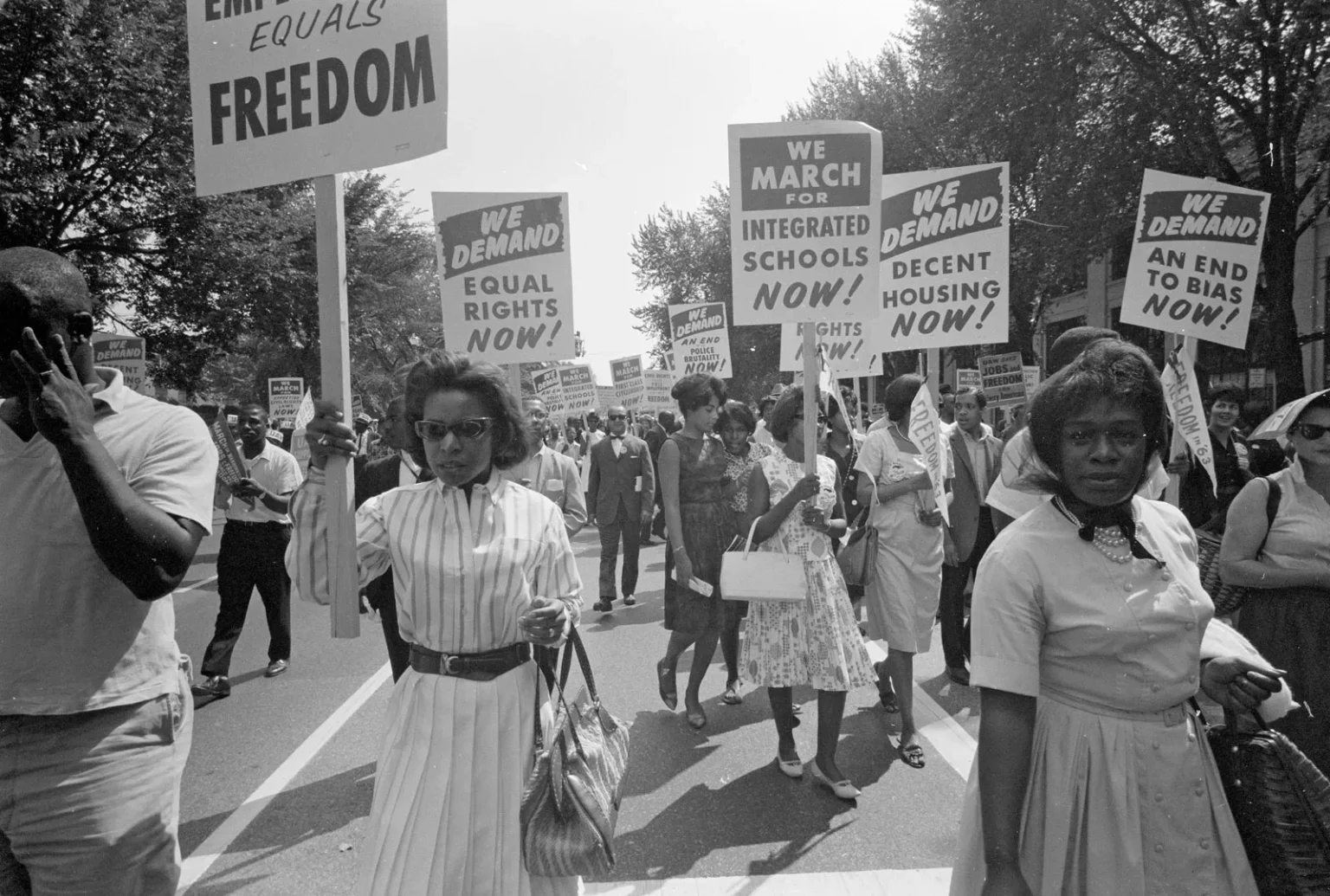
- The March on Washington for Jobs and Freedom (1963): This massive demonstration brought over 250,000 people to the nation’s capital in a powerful call for both civil rights and economic justice. The event culminated in Dr. King’s iconic “I Have a Dream” speech at the Lincoln Memorial.
- The Selma to Montgomery Marches (1965): A campaign focused on securing voting rights in Selma, Alabama, led to a march that was brutally attacked by state troopers on the Edmund Pettus Bridge. The televised violence of “Bloody Sunday” galvanized public opinion and provided President Lyndon B. Johnson with the political momentum to pass sweeping voting rights legislation.
The strategic genius of the direct-action movement was its use of nonviolence to expose the inherent violence of the Jim Crow system to a national television audience. By peacefully provoking a confrontation, activists made the brutality of segregation visible and undeniable. This transformed a regional issue into a national moral crisis that the federal government, concerned with its image during the Cold War, could no longer ignore. Nonviolence was not a passive strategy but an aggressive one—a method of moral and political jujitsu that used the opponent’s own violence to win the battle for public opinion, the necessary prerequisite for legislative change.
Legislative Victories and Their Limits
The moral pressure created by the grassroots movement culminated in two of the most significant legislative achievements in American history. Pushed through Congress by President Lyndon B. Johnson, these laws effectively dismantled the legal infrastructure of Jim Crow.
The Civil Rights Act of 1964 was the most comprehensive civil rights law since Reconstruction. Its key provisions included:
- Title I: Barred unequal application of voter registration requirements.
- Title II: Outlawed discrimination and segregation in public accommodations such as hotels, restaurants, and theaters.
- Title IV: Authorized the U.S. Attorney General to file lawsuits to desegregate public schools.
- Title VI: Prohibited discrimination by any program or activity receiving federal financial assistance, creating a powerful enforcement tool.
- Title VII: Banned discrimination in employment on the basis of race, color, religion, sex, or national origin, and established the Equal Employment Opportunity Commission (EEOC) to investigate complaints.
The Voting Rights Act of 1965 was passed in the wake of the Selma marches and was designed to finally enforce the 15th Amendment. The act outlawed discriminatory practices like literacy tests and authorized the federal government to oversee voter registration and elections in jurisdictions with a history of disenfranchisement. The impact was immediate and dramatic, leading to a massive increase in Black voter registration and the election of thousands of Black officials across the South in the ensuing years.
These legislative victories represented the successful culmination of the fight against de jure (legal) segregation. They tore down the “Whites Only” signs and opened the doors to polling booths. However, they were less equipped to address the deep-seated de facto segregation and systemic economic inequalities that were not explicitly codified in law, particularly in the urban North and West. The laws could ban discriminatory hiring, but they could not instantly fix the educational disparities that left many Black applicants less qualified on paper. They could desegregate a lunch counter, but they could not desegregate a suburban neighborhood built on decades of discriminatory housing policies. This limitation set the stage for the next phase of the struggle for racial justice. The Watts Riots in Los Angeles in 1965, which erupted just days after the Voting Rights Act was signed, were a stark signal that ending Jim Crow laws was not the end of the struggle against racism in America.
Part IV: The Persistence of the Color Line: Systemic Racism in Contemporary America
While the Civil Rights Movement successfully outlawed overt, legal segregation, its legacy persists through interconnected, self-reinforcing systems of inequality. Modern American racism is less about individual prejudice and more about the durable structures that perpetuate racial disparities. This section provides a data-driven analysis of how systemic racism operates in the justice system, the economy, education, and healthcare, demonstrating that the color line, though less visible, remains a defining feature of American life.
The New Jim Crow: Mass Incarceration and the Justice System
In the decades following the Civil Rights Movement, a new system of racial caste has emerged in the United States: mass incarceration. The scale of the American prison system is globally unprecedented, and its racial disparities are staggering, leading many scholars and activists to label it “The New Jim Crow”. This system’s roots can be traced directly to the aftermath of the Civil War, when Southern states enacted “Black Codes” and used the criminal justice system to control newly freed African Americans, leading to the nation’s first prison boom in 1865. The modern era of mass incarceration began in the 1970s, fueled by politically charged “law and order” rhetoric and a “War on Drugs” that disproportionately targeted communities of color.
The data reveals a justice system that operates with a profound racial bias at every level:
- Policing: A Black person is five times more likely to be stopped by police without just cause than a white person. Despite African Americans and whites using drugs at similar rates, the imprisonment rate for African Americans on drug charges is nearly six times that of whites.
- Incarceration: African Americans are incarcerated at more than five times the rate of whites. While constituting about 13% of the U.S. population, Black people make up 37% of the combined jail and prison population. Projections indicate that one in three Black boys born today can expect to be sentenced to prison in his lifetime, compared to just one in seventeen white boys.
- Courts and Sentencing: Bias permeates the court system, from the selection of all-white juries to the application of capital punishment. Black people account for 35% of all individuals executed under the death penalty in the last 40 years, and cases involving white victims are far more likely to result in a death sentence.
The systemic nature of this violence was laid bare for the world to see on May 25, 2020, with the murder of George Floyd. Floyd, an unarmed 46-year-old Black man, was murdered by Derek Chauvin, a white Minneapolis police officer, who knelt on his neck for over nine minutes while he was handcuffed and pleading for his life. The killing, captured on bystander video, sparked the largest protests in U.S. history and a global reckoning with police brutality and systemic racism. The event inflicted a “collective moral injury,” leading to unprecedented levels of reported anger, sadness, depression, and anxiety, with the psychological burden falling most heavily on Black Americans. The subsequent trial and conviction of Chauvin for murder was a rare instance of police accountability, made possible largely by the irrefutable video evidence.
The murder of George Floyd was not an isolated incident but the predictable outcome of a system that has historically been used as a tool of racial and social control. The vast and consistent statistical disparities are too great to be explained by individual biases alone; they point to a structure that systematically devalues Black lives.
| Metric | Black Rate/Percentage | White Rate/Percentage | Disparity Ratio (Black vs. White) | |
| Likelihood of Police Stop w/o Cause | 5x more likely | Baseline (1x) | 5.0 to 1 | |
| Incarceration Rate | >5x higher | Baseline (1x) | >5.0 to 1 | |
| Incarceration Rate for Drug Offenses | ~6x higher | Baseline (1x) | ~6.0 to 1 | |
| Lifetime Likelihood of Imprisonment (Male) | 1 in 3 | 1 in 17 | 5.7 to 1 | |
| % of Prison Population vs. General Population | 37% vs. 13% | 30% vs. 60% | Disproportionately High | |
| % of Death Penalty Executions (last 40 yrs) | 35% | 55% | Disproportionately High | |
| Table 1: Disparities in the U.S. Criminal Justice System. Data compiled from sources. |
The Racial Wealth Gap: The Enduring Legacy of Economic Exclusion
The most durable and consequential legacy of American racism is the vast and persistent racial wealth gap. This is not a gap in income, which measures earnings, but in wealth, which represents the accumulated assets (savings, property, stocks) that provide financial security and opportunity across generations. As of 2022, the median white household held wealth of $285,000, while the median Black household held just $44,890. This means that for every $100 in wealth held by a white family, a Black family holds only $15. This staggering gap is not the result of individual choices but the direct consequence of centuries of discriminatory policies designed to exclude African Americans from opportunities for wealth accumulation.
The primary driver of this gap has been the denial of homeownership. For most of the 20th century, homeownership was the principal vehicle for middle-class wealth creation in the United States. However, a combination of federal policy and private practice systematically locked Black families out of this opportunity. Beginning in the 1930s, the federal government’s Home Owners’ Loan Corporation created maps of American cities that graded neighborhoods for mortgage lending risk. Neighborhoods with minority residents were almost invariably outlined in red and deemed “hazardous,” a practice that became known as redlining. This official policy made it nearly impossible for Black families to secure mortgages to buy homes or for residents of Black neighborhoods to get loans for home improvements. At the same time, government programs like the Federal Housing Administration (FHA) and the GI Bill subsidized the creation of white suburbs, effectively underwriting a massive transfer of wealth to white Americans while explicitly excluding Black Americans.
The legacy of these policies is stark. Today, the homeownership rate for white individuals is nearly 73%, compared to only 44% for Black individuals. This disparity in housing equity is a primary driver of the overall wealth gap. The wealth accumulated by white families through government-subsidized homeownership is now being passed down to subsequent generations, funding college education, providing down payments for new homes, and enabling investment in the stock market—which explains why stock equity makes up nearly 30% of white wealth but only 4% of Black wealth. Having been systematically denied this initial accumulation, Black families are left with little to no intergenerational wealth to pass on, creating a cycle of disadvantage that individual effort alone cannot break.
| Metric | White Households | Black Households | Hispanic Households | |
| Median Household Wealth (2022) | $285,000 | $44,890 | $62,000 | |
| Median Wealth Change (2019-2022) | +$51,800 | +$16,920 | N/A | |
| Homeownership Rate | ~73% | 44% | N/A | |
| Share of Wealth Growth from Stock Equity | ~30% | 4% | 4% | |
| Share of Wealth Growth from Housing Equity | 22% | 21% | N/A | |
| Table 2: The Racial Wealth and Homeownership Gap. Data compiled from source. |
Inequality in Opportunity: Disparities in Education and Healthcare
Systemic racism also manifests in unequal access to the fundamental building blocks of a successful and healthy life: education and healthcare. These disparities are not separate issues but are deeply intertwined with the economic and geographic segregation detailed previously. Where a person lives—a factor heavily influenced by the legacy of redlining—often dictates the quality of their schools, their access to medical care, and their exposure to environmental health hazards. This creates a vicious feedback loop where disadvantages in one area amplify disadvantages in another.
In the realm of education, racial disparities begin early and compound over a lifetime:
- Resource Inequity: Because public schools are primarily funded by local property taxes, racially segregated neighborhoods with lower property values have chronically underfunded schools. This results in fewer resources, less experienced and uncertified teachers, and a lack of access to advanced coursework. For example, high schools with high enrollments of Black and Latino students are significantly less likely to offer courses like calculus and computer science.
- Disciplinary Bias: The school-to-prison pipeline is a stark reality. Black students face far harsher disciplinary measures than their white peers for similar infractions. Black boys represent 8% of K-12 enrollment but account for 22% of out-of-school suspensions and 21% of expulsions. Black children are also 1.3 times more likely than white children to attend a school with a police officer but no school counselor, criminalizing student behavior rather than addressing its root causes.
In healthcare, the disparities are a matter of life and death:
- Access to Care: Disparities in health insurance coverage persist. As of 2023, the uninsured rate for Black people (9.7%) was 1.5 times higher than for white people (6.5%). Predominantly Black zip codes are also 67% more likely to have a shortage of primary care physicians.
- Health Outcomes: This unequal access leads to dramatically worse health outcomes. Black Americans have lower life expectancies and higher rates of chronic conditions like high blood pressure. The disparities are particularly shocking in maternal and infant health. The infant mortality rate for Black babies is more than double that for white babies (11 vs. 5 per 1,000 births), and Black mothers are three to four times more likely to die from pregnancy-related causes than white mothers.
- Implicit Bias: These outcomes are exacerbated by implicit bias within the medical profession. Studies have shown that many white medical students harbor false beliefs about biological differences between races, such as the idea that Black people have a higher tolerance for pain, which leads to the undertreatment of Black patients.
| Metric | Black Population | White Population | Other Groups | |
| Uninsured Rate (Adults, 2023) | 9.7% | 6.5% | Hispanic: 17.9% | |
| Infant Mortality Rate (per 1,000 births) | 11.1 | 5.0 | Hispanic: 5.0 | |
| Maternal Mortality Rate (ratio vs. White) | 3-4x higher | Baseline (1x) | N/A | |
| Access to Calculus in High School | 35% (high-minority schools) | 54% (low-minority schools) | N/A | |
| Out-of-School Suspension Rate (% of total) | 22% (Black boys) | N/A (8% of enrollment) | N/A | |
| Table 3: Key Indicators of Health and Education Inequality. Data compiled from sources. |
The Black Lives Matter Movement and the Future of Race Relations
The most significant contemporary expression of Black resistance is the Black Lives Matter (BLM) movement. Born in 2013 with a hashtag after the acquittal of George Zimmerman in the killing of teenager Trayvon Martin, BLM evolved into a decentralized, international activist movement campaigning against systemic racism and police violence. The movement gained national prominence after the 2014 police killing of Michael Brown in Ferguson, Missouri, and exploded into a global phenomenon following the murder of George Floyd in 2020.
BLM represents a crucial evolution in the Black freedom struggle. Its guiding principles are explicitly intersectional, inclusive, and global. The movement is “Unapologetically Black,” “Trans Affirming,” and “Queer Affirming,” intentionally centering the experiences of those who have been marginalized even within past Black liberation movements. Its ultimate vision is abolitionist, imagining a world divested from police and prisons and invested instead in community-based models of safety, justice, and healing. This framework is a direct response to the failures of past reforms to eradicate systemic violence and inequality. Where the mid-20th-century Civil Rights Movement sought legal inclusion within existing American systems, BLM fundamentally questions the legitimacy of those systems themselves. The call to “defund the police” is a logical conclusion drawn from the historical evidence that reforms have been insufficient to stop state-sanctioned violence against Black communities. It argues that the system is not broken but is functioning as it was designed—as a system of racial control.
The movement has successfully forced a national reckoning on race, but the public discourse remains highly polarized. A majority of Americans (58%) believe race relations in the U.S. are bad, and two-thirds say it has become more common for people to express racist views since 2016. There is a significant partisan and racial divide in perceptions of racism. For example, 87% of Black adults say the criminal justice system is more unjust towards Black people, a view shared by only 61% of white adults. Concepts like “systemic racism” have become central but highly controversial terms in public debates, indicating that the nation is still deeply divided on the nature of the problem, let alone the solution.
Part V: Legacy and Contribution
To focus solely on the history of oppression is to tell only half of the story of the African-American journey. Parallel to the struggle against racism is a powerful narrative of agency, creation, and cultural innovation. Forged in the crucible of slavery and Jim Crow, African-American culture is not a separate or niche category but is, in fact, the bedrock of American popular culture and a profound force in the nation’s political and social development.
An Indelible Mark on American Culture
African-American creativity has left an “indelible mark” on nearly every facet of American life, from music and literature to film, fashion, and art. Through their art, Black artists have preserved history, sustained community memory, and fostered empowerment in the face of relentless oppression.
- Music: The entire trajectory of American popular music is inseparable from Black innovation. From the creation of spirituals and gospel music in the crucible of slavery, which served as expressions of faith and coded messages of resistance, to the birth of the blues in the Mississippi Delta, jazz in New Orleans, soul in Detroit, and hip-hop in the Bronx, African Americans have been the primary architects of America’s sonic identity.
- Literature: The American literary canon has been profoundly shaped and challenged by the works of African-American authors. Writers from Phillis Wheatley and W.E.B. Du Bois to Zora Neale Hurston, Richard Wright, James Baldwin, Maya Angelou, and Nobel laureate Toni Morrison have explored the complex realities of race, identity, and the American experience, forcing the nation to confront its contradictions.
- Arts and Cultural Movements: African Americans have spearheaded major cultural movements that have set global standards. The Harlem Renaissance of the 1920s was a flourishing of art, music, and literature that sought to define a “New Negro” identity. In the visual arts, sculptors like Edmonia Lewis and painters like Jacob Lawrence and Jean-Michel Basquiat have redefined the boundaries of American art.
- Political Contributions: The fight to expand and perfect American democracy has been consistently led by African Americans. From the thousands who held public office during Reconstruction to the legal and legislative battles waged by the NAACP and the mass mobilizations of the Civil Rights Movement, the struggle for Black freedom has always been a struggle to make America live up to its founding ideals.
This history of cultural production reveals a central paradox of the American experience. African-American culture has historically served a dual purpose: it has been a powerful tool of resistance and community preservation, while simultaneously becoming the nation’s most significant cultural export. The very culture of a people who have been systematically excluded is the culture that most defines the nation to itself and to the world. This creates a dynamic of cultural consumption and appropriation alongside social and economic oppression—a contradiction that lies at the heart of America’s unresolved racial dilemma.
Conclusion: The Unfinished Journey
The 400-year journey of African Americans in the United States is a story of profound contradiction. It is a narrative defined by the persistent and adaptive nature of racism, which has evolved from the overt brutality of chattel slavery and Jim Crow to the more insidious, yet no less damaging, systemic inequalities that structure contemporary American society. The data and historical evidence presented in this report demonstrate an unbroken line connecting the past to the present: the economic logic that commodified Black bodies in the 17th century laid the groundwork for the racial wealth gap today; the system of social control that enforced slavery and Jim Crow finds its modern echo in the racial disparities of the mass incarceration system; and the residential segregation codified in the 20th century continues to produce deep inequalities in education and health outcomes.
Yet, this is also a story of extraordinary resilience, agency, and democratic striving. At every stage of this journey, African Americans have resisted their oppression and fought to expand the meaning of freedom for all Americans. The struggle for Black liberation has consistently forced the United States to confront the vast chasm between its professed ideals of liberty and equality and its lived reality of racial hierarchy. The journey for racial equality is, therefore, far from over. The challenges remain immense, the disparities are stark, and the national conversation is fraught with division. But the dual legacies of this journey—the deep wounds of racism and the unyielding spirit of the Black freedom struggle—continue to shape the nation’s identity and define its unfinished quest to become a more perfect union.

